
Winning a GSA contract can change the trajectory of a small business, but getting one takes more than filling out a form. The process rewards companies that prepare their pricing, their paperwork, and their patience in equal measure. This guide walks through the nine steps our Authorized Negotiators use with every client pursuing a GSA Schedule contract, from the first eligibility check to your first sale on GSA Advantage.
Why Getting a GSA Contract Is Worth the Effort
The GSA Multiple Award Schedule is the largest government commercial acquisition program in the world. It closed FY2025 with $50.6 billion in sales across roughly 14,579 active contractors (GSA SSQ+, 2025). Small businesses hold about 80% of those contracts and collect 36% of the award dollars, so this is not a program built only for large primes.
The broader numbers make the opportunity clearer. Federal agencies awarded $179 billion in prime contracts to small businesses in FY2025, 28% of all federal prime contracting dollars that year (SBA, June 2026). A GSA Schedule is one of the fastest ways to become a vendor agencies can buy from directly, without a competitive bid, on smaller orders.
Set-aside programs add another layer of opportunity if your business qualifies. Service-Disabled Veteran-Owned Small Businesses received $32.5 billion in prime contracts in FY2025 alone, ahead of their 5% federal goal (SBA, June 2026). GSA itself earned an A+ on the FY2025 SBA small business procurement scorecard, which means the agency you would be contracting through is graded on how well it buys from businesses like yours.
If you want the plain-English version of how a GSA contract actually works once you have one, read How Does a GSA Contract Work? A Plain-English Guide. This post focuses on getting there.
Step 1: Confirm You Meet GSA Schedule Eligibility
Before you spend time on an application, confirm you actually qualify. A GSA Schedule requires at least two years of operating history, financial stability, and a commercially available product or service already selling in the open market. GSA will not build a schedule around something you have not sold yet.
We wrote a full eligibility checklist in Do You Qualify for a GSA Contract? Quick Eligibility Guide, so we will not repeat it here. The short version: if you already sell commercially and can document two years of sales, you likely qualify. The step most companies skip is checking whether their specific product category already has too many awarded contractors to make entry worthwhile.
Step 2: Research Federal Demand Before You Apply
Not every product category is worth pursuing. Some Special Item Numbers already have hundreds of awarded contractors competing for the same buyers, and adding yourself to a crowded category rarely pays off in the first two years.
Two tools tell you what you are walking into. GSA eLibrary shows exactly who already holds a contract in your category and how many competitors you would face. FPDS shows what agencies have actually purchased and from whom, which tells you whether the demand is real or theoretical. SAM.gov rounds this out by listing open solicitations in your space.
Here is the part most applicants skip: they check whether GSA accepts their product category, but they never check whether federal buyers are actually purchasing in it. A crowded, low-demand category is a worse outcome than skipping a Schedule entirely, because you have sunk the application effort into a contract nobody uses.
Step 3: Prepare Your GSA Offer Documentation
This step decides whether your file gets reviewed quickly or gets kicked back with questions. A complete GSA offer needs:
- Financial statements, including balance sheets and profit and loss statements
- Three to five past performance references, ideally recent and verifiable
- A commercial price list with your full discount structure
- Corporate experience narratives specific to your product or service category
- Technical proposals with compliance certifications for every item you list
Most delays we see are not caused by ineligibility. They come from incomplete files. A contracting officer who has to request a missing document sets your file aside while they wait for your response, and that alone can add weeks to a review that would otherwise move in days.
Build every document as if you are handing it to someone who has reviewed a thousand of these and will notice the one number that does not match across two pages.
Step 4: Build a Pricing Strategy GSA Will Accept
GSA pricing comes down to one standard: fair and reasonable pricing compared to your best commercial customer. Your Schedule price should sit at or below what your Most Favored Customer pays, adjusted for any real differences in order size or terms.
We cover the full mechanics in Making The Ultimate Pricing Strategies For Your Products On GSA MAS Schedules, including how volume discounts and prompt payment terms affect your negotiating position. The short version here: know your Most Favored Customer relationship cold before you submit a number, because a contracting officer will ask you to defend it.
Step 5: Register in SAM.gov and Get Your Unique Entity ID
You cannot submit a GSA offer without an active SAM.gov registration and a Unique Entity ID (UEI). Start this early. Registration can take one to two weeks to process, longer if any information does not match your other federal records exactly.
Keep this registration current every year. A lapsed SAM.gov registration suspends your eligibility for federal payment, which means an active GSA Schedule contract with a lapsed registration cannot get paid until you fix it.
Step 6: Submit Your Proposal Through GSA eOffer/eMod
GSA eOffer/eMod is the portal where your proposal gets submitted, reviewed, and eventually awarded. Before you submit, complete the required Pathways to Success training, which GSA requires of every first-time Schedule applicant.
Use the portal’s Price Proposal Templates exactly as formatted. Contracting officers process hundreds of these submissions, and a proposal that follows the expected format moves through review noticeably faster than one that reformats the requested information on its own terms.
Step 7: Get Ready to Negotiate
Once a contracting officer reviews your proposal, expect questions. Most negotiations focus on pricing adjustments, technical clarifications, and contract terms, and it is normal for a contracting officer to push back on more than one of these before your file is approved.
Here is what surprises first-time applicants the most: negotiation is not a sign your offer was weak. It is the standard process, and contracting officers use it on strong proposals as often as weak ones. Respond promptly, bring documentation for every number you defend, and treat each round as routine rather than a setback.
Step 8: Stay Compliant After You Win the Contract
Winning the contract is the beginning of the obligations, not the end of them. Every Schedule holder must report sales and, as of Refresh 31 in April 2026, submit Transactional Data Reporting (TDR) monthly through the FAS Sales Reporting Portal, along with paying the 0.75% Industrial Funding Fee each quarter.
TDR is now mandatory across every Special Item Number, and GSA is actively removing contracts that fall short of their minimum sales thresholds. The contractor base dropped from about 16,108 in FY2024 to roughly 14,579 in FY2025, a reduction of about 1,500 contracts in a single year. We cover the full TDR shift in GSA’s Price Reduction Clause And The Shift To TDR Reporting if you want the compliance details in one place.
Step 9: Get Your Products in Front of Federal Buyers
A GSA contract with no visibility on GSA Advantage might as well not exist. Contracting officers search GSA Advantage by delivery time and current pricing, so an outdated or thin catalog listing gets skipped even when your underlying products are competitive.
We wrote a full visibility guide in How To Get Found On GSA Advantage: Visibility Tips, covering how listings actually get surfaced to buyers. The short version: list your full catalog immediately after award, keep pricing current, and do not wait for buyers to find you. No federal agency shows up with a purchase order in hand for a vendor it cannot find.
Where Most Businesses Get This Wrong
Three mistakes account for most of the GSA offers that stall or get rejected.
The first is submitting before pricing is fully documented. Contracting officers flag an incomplete pricing narrative immediately, and it is one of the most common reasons a file gets sent back for revision instead of moving forward.
The second is applying in an oversaturated category without checking real federal demand first. GSA eLibrary and FPDS both exist to answer this question before you apply, not after you win a contract nobody buys from.
The third is treating post-award compliance as optional. A Schedule holder that ignores TDR reporting or misses minimum sales thresholds is at real risk of non-renewal, not just a warning letter. GSA’s active rightsizing of its contractor base in FY2025 shows this is enforced, not theoretical.
How GSA Contract Services Helps With GSA Contract Acquisition
Most companies attempting this alone spend 8 to 12 months from first document to contract award, and even a well-prepared file can still come back with questions. This is where a firm that has done this for 250 clients since 1995 changes the odds.
Our Authorized Negotiators handle the parts that stall most applicants: building a pricing model that survives negotiation, assembling a complete offer package on the first submission, and managing the back-and-forth with your contracting officer directly. Once you are awarded, we manage contract modifications, extensions, and renewals through our Annual Contract Management Program, and we help you list and maintain your catalog on GSA Advantage so the contract actually generates sales. For products that need electronic ordering, our EDI services connect your systems directly to federal purchasing platforms.
If you want us to run this process for you starting with the first document, start with Get A GSA Contract.
Quick Recap
Getting a GSA contract comes down to nine steps: confirm eligibility, research real demand, prepare complete documentation, build defensible pricing, register in SAM.gov, submit through eOffer/eMod, negotiate in good faith, stay compliant after award, and get visible on GSA Advantage. Most applicants who fail at one of these steps fail at pricing documentation or post-award compliance, not at the application itself.
Frequently Asked Questions
How long does it take to get a GSA contract?
Most GSA Schedule applications take 8 to 12 months from first submission to award. A complete, well-documented offer can move faster; an incomplete one almost always moves slower.
How much does a GSA contract cost to maintain?
You pay an Industrial Funding Fee of 0.75% of your GSA sales each quarter, plus the time cost of monthly TDR reporting. There is no separate fee to apply for the Schedule itself.
Can a new business apply for a GSA contract?
You need at least two years of operating history with commercial sales in your product category before GSA will consider your offer. Businesses under two years old should build that track record first.
What happens if I miss my minimum sales requirement?
GSA can decline to renew your contract. You must reach $100,000 in sales during your first five-year base period and $125,000 in each five-year option period after that.
Ready to Get Your GSA Contract?
If you are ready to start, or you want a second opinion on a proposal you have already drafted, our Authorized Negotiators can walk you through what your specific product category needs. Contact us to get started.
GSA Contract Services, LLC | 4622 Cedar Avenue, Suite 123, Wilmington, NC 28403 | 202-280-7060 | Sales@GSA-CS.com
Why Getting a GSA Contract Is Worth the Effort
The GSA Multiple Award Schedule is the largest government commercial acquisition program in the world. It closed FY2025 with $50.6 billion in sales across roughly 14,579 active contractors (GSA SSQ+, 2025). Small businesses hold about 80% of those contracts and collect 36% of the award dollars, so this is not a program built only for large primes.
The broader numbers make the opportunity clearer. Federal agencies awarded $179 billion in prime contracts to small businesses in FY2025, 28% of all federal prime contracting dollars that year (SBA, June 2026). A GSA Schedule is one of the fastest ways to become a vendor agencies can buy from directly, without a competitive bid, on smaller orders.
Set-aside programs add another layer of opportunity if your business qualifies. Service-Disabled Veteran-Owned Small Businesses received $32.5 billion in prime contracts in FY2025 alone, ahead of their 5% federal goal (SBA, June 2026). GSA itself earned an A+ on the FY2025 SBA small business procurement scorecard, which means the agency you would be contracting through is graded on how well it buys from businesses like yours.
If you want the plain-English version of how a GSA contract actually works once you have one, read How Does a GSA Contract Work? A Plain-English Guide. This post focuses on getting there.
Step 1: Confirm You Meet GSA Schedule Eligibility
Before you spend time on an application, confirm you actually qualify. A GSA Schedule requires at least two years of operating history, financial stability, and a commercially available product or service already selling in the open market. GSA will not build a schedule around something you have not sold yet.
We wrote a full eligibility checklist in Do You Qualify for a GSA Contract? Quick Eligibility Guide, so we will not repeat it here. The short version: if you already sell commercially and can document two years of sales, you likely qualify. The step most companies skip is checking whether their specific product category already has too many awarded contractors to make entry worthwhile.
Step 2: Research Federal Demand Before You Apply
Not every product category is worth pursuing. Some Special Item Numbers already have hundreds of awarded contractors competing for the same buyers, and adding yourself to a crowded category rarely pays off in the first two years.
Two tools tell you what you are walking into. GSA eLibrary shows exactly who already holds a contract in your category and how many competitors you would face. FPDS shows what agencies have actually purchased and from whom, which tells you whether the demand is real or theoretical. SAM.gov rounds this out by listing open solicitations in your space.
Here is the part most applicants skip: they check whether GSA accepts their product category, but they never check whether federal buyers are actually purchasing in it. A crowded, low-demand category is a worse outcome than skipping a Schedule entirely, because you have sunk the application effort into a contract nobody uses.
Step 3: Prepare Your GSA Offer Documentation
This step decides whether your file gets reviewed quickly or gets kicked back with questions. A complete GSA offer needs:
- Financial statements, including balance sheets and profit and loss statements
- Three to five past performance references, ideally recent and verifiable
- A commercial price list with your full discount structure
- Corporate experience narratives specific to your product or service category
- Technical proposals with compliance certifications for every item you list
Most delays we see are not caused by ineligibility. They come from incomplete files. A contracting officer who has to request a missing document sets your file aside while they wait for your response, and that alone can add weeks to a review that would otherwise move in days.
Build every document as if you are handing it to someone who has reviewed a thousand of these and will notice the one number that does not match across two pages.
Step 4: Build a Pricing Strategy GSA Will Accept
GSA pricing comes down to one standard: fair and reasonable pricing compared to your best commercial customer. Your Schedule price should sit at or below what your Most Favored Customer pays, adjusted for any real differences in order size or terms.
We cover the full mechanics in Making The Ultimate Pricing Strategies For Your Products On GSA MAS Schedules, including how volume discounts and prompt payment terms affect your negotiating position. The short version here: know your Most Favored Customer relationship cold before you submit a number, because a contracting officer will ask you to defend it.
Step 5: Register in SAM.gov and Get Your Unique Entity ID
You cannot submit a GSA offer without an active SAM.gov registration and a Unique Entity ID (UEI). Start this early. Registration can take one to two weeks to process, longer if any information does not match your other federal records exactly.
Keep this registration current every year. A lapsed SAM.gov registration suspends your eligibility for federal payment, which means an active GSA Schedule contract with a lapsed registration cannot get paid until you fix it.
Step 6: Submit Your Proposal Through GSA eOffer/eMod
GSA eOffer/eMod is the portal where your proposal gets submitted, reviewed, and eventually awarded. Before you submit, complete the required Pathways to Success training, which GSA requires of every first-time Schedule applicant.
Use the portal’s Price Proposal Templates exactly as formatted. Contracting officers process hundreds of these submissions, and a proposal that follows the expected format moves through review noticeably faster than one that reformats the requested information on its own terms.
Step 7: Get Ready to Negotiate
Once a contracting officer reviews your proposal, expect questions. Most negotiations focus on pricing adjustments, technical clarifications, and contract terms, and it is normal for a contracting officer to push back on more than one of these before your file is approved.
Here is what surprises first-time applicants the most: negotiation is not a sign your offer was weak. It is the standard process, and contracting officers use it on strong proposals as often as weak ones. Respond promptly, bring documentation for every number you defend, and treat each round as routine rather than a setback.
Step 8: Stay Compliant After You Win the Contract
Winning the contract is the beginning of the obligations, not the end of them. Every Schedule holder must report sales and, as of Refresh 31 in April 2026, submit Transactional Data Reporting (TDR) monthly through the FAS Sales Reporting Portal, along with paying the 0.75% Industrial Funding Fee each quarter.
TDR is now mandatory across every Special Item Number, and GSA is actively removing contracts that fall short of their minimum sales thresholds. The contractor base dropped from about 16,108 in FY2024 to roughly 14,579 in FY2025, a reduction of about 1,500 contracts in a single year. We cover the full TDR shift in GSA’s Price Reduction Clause And The Shift To TDR Reporting if you want the compliance details in one place.
Step 9: Get Your Products in Front of Federal Buyers
A GSA contract with no visibility on GSA Advantage might as well not exist. Contracting officers search GSA Advantage by delivery time and current pricing, so an outdated or thin catalog listing gets skipped even when your underlying products are competitive.
We wrote a full visibility guide in How To Get Found On GSA Advantage: Visibility Tips, covering how listings actually get surfaced to buyers. The short version: list your full catalog immediately after award, keep pricing current, and do not wait for buyers to find you. No federal agency shows up with a purchase order in hand for a vendor it cannot find.
Where Most Businesses Get This Wrong
Three mistakes account for most of the GSA offers that stall or get rejected.
The first is submitting before pricing is fully documented. Contracting officers flag an incomplete pricing narrative immediately, and it is one of the most common reasons a file gets sent back for revision instead of moving forward.
The second is applying in an oversaturated category without checking real federal demand first. GSA eLibrary and FPDS both exist to answer this question before you apply, not after you win a contract nobody buys from.
The third is treating post-award compliance as optional. A Schedule holder that ignores TDR reporting or misses minimum sales thresholds is at real risk of non-renewal, not just a warning letter. GSA’s active rightsizing of its contractor base in FY2025 shows this is enforced, not theoretical.
How GSA Contract Services Helps With GSA Contract Acquisition
Most companies attempting this alone spend 8 to 12 months from first document to contract award, and even a well-prepared file can still come back with questions. This is where a firm that has done this for 250 clients since 1995 changes the odds.
Our Authorized Negotiators handle the parts that stall most applicants: building a pricing model that survives negotiation, assembling a complete offer package on the first submission, and managing the back-and-forth with your contracting officer directly. Once you are awarded, we manage contract modifications, extensions, and renewals through our Annual Contract Management Program, and we help you list and maintain your catalog on GSA Advantage so the contract actually generates sales. For products that need electronic ordering, our EDI services connect your systems directly to federal purchasing platforms.
If you want us to run this process for you starting with the first document, start with Get A GSA Contract.
Quick Recap
Getting a GSA contract comes down to nine steps: confirm eligibility, research real demand, prepare complete documentation, build defensible pricing, register in SAM.gov, submit through eOffer/eMod, negotiate in good faith, stay compliant after award, and get visible on GSA Advantage. Most applicants who fail at one of these steps fail at pricing documentation or post-award compliance, not at the application itself.
Frequently Asked Questions
How long does it take to get a GSA contract?
Most GSA Schedule applications take 8 to 12 months from first submission to award. A complete, well-documented offer can move faster; an incomplete one almost always moves slower.
How much does a GSA contract cost to maintain?
You pay an Industrial Funding Fee of 0.75% of your GSA sales each quarter, plus the time cost of monthly TDR reporting. There is no separate fee to apply for the Schedule itself.
Can a new business apply for a GSA contract?
You need at least two years of operating history with commercial sales in your product category before GSA will consider your offer. Businesses under two years old should build that track record first.
What happens if I miss my minimum sales requirement?
GSA can decline to renew your contract. You must reach $100,000 in sales during your first five-year base period and $125,000 in each five-year option period after that.
Ready to Get Your GSA Contract?
If you are ready to start, or you want a second opinion on a proposal you have already drafted, our Authorized Negotiators can walk you through what your specific product category needs. Contact us to get started.
GSA Contract Services, LLC | 4622 Cedar Avenue, Suite 123, Wilmington, NC 28403 | 202-280-7060 | Sales@GSA-CS.com
Below are essential tips to successfully acquire a GSA contract and position your business for success in the federal marketplace.
1. Understand GSA Schedules and Eligibility
Before pursuing a GSA contract, familiarize yourself with the GSA Schedule program. The GSA Schedule (also known as the Multiple Award Schedule or MAS) is a long-term government-wide contract that provides federal agencies with access to commercial products and services at pre-negotiated prices.
Key Considerations:
- Your business must have at least two years of operational experience with financial stability.
- Your company should offer commercially available products or services.
- Your pricing must be competitive and compliant with federal pricing guidelines.
2. Conduct Market Research
Understanding the federal demand for your product or service is crucial. If your offerings are not included, or if there are too many already established players in your specific business, it may be a wise choice to be prudent with the type of Schedule you get into.
Utilize government resources such as:
- SAM.gov (System for Award Management) for contract opportunities
- GSA eLibrary to analyze competitors’ awarded contracts
- FPDS (Federal Procurement Data System) for insights on federal purchasing trends
This research will help determine if a GSA contract is the right fit for your business.
3. Prepare Required Documentation
A GSA contract application requires extensive documentation, including:
- Financial statements (Balance Sheets, Profit & Loss statements)
- Past performance references (minimum of 3-5 positive references)
- Commercial price list and discount structure
- Corporate experience narratives
- Technical proposals and compliance certifications
Ensure all documents are accurate, up-to-date, and aligned with GSA requirements. This is the most important and time-consuming part of GSA Contract acquisition which requires extreme thoroughness and dedication on the part of a business owner. Do not neglect this step even slightly, or your chances of getting a GSA Contract drastically go down.
4. Develop a Competitive Pricing Strategy
GSA pricing is a major factor in contract approval. The government seeks Fair and Reasonable Pricing, which means:
- Your prices should be lower than or equal to your Most Favored Customer (MFC).
- Discounts and volume pricing should be structured strategically.
- Offering prompt payment discounts can make your offer more attractive.
GSA often negotiates pricing, so be prepared to justify your rates with commercial sales practices and pricing data. Make sure that you are not incurring losses when putting forward pricing strategies to the GSA.
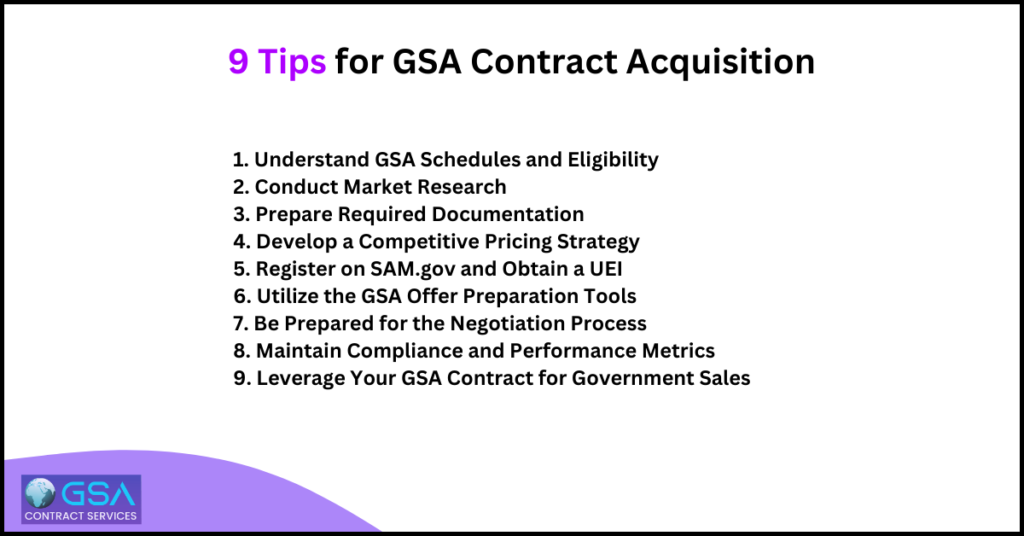
5. Register on SAM.gov and Obtain a UEI
Before submitting your GSA offer, your company must be registered in the System for Award Management (SAM.gov) and obtain a Unique Entity Identifier (UEI). This process ensures your company is eligible to conduct business with the federal government.
6. Utilize the GSA Offer Preparation Tools
The GSA provides online tools to simplify the submission process:
- GSA eOffer/eMod: The portal where vendors submit their proposals
- Price Proposal Templates: Ensure compliance with GSA pricing structures
- Pathways to Success training module: A required step for first-time applicants
Using these tools correctly increases the chances of a successful submission. They are the gateways of proposal submission for your GSA Contracts.
7. Be Prepared for the Negotiation Process
Once your proposal is reviewed, GSA contracting officers may request clarifications, modifications, or negotiations regarding:
- Pricing adjustments
- Technical details
- Contract terms and conditions
Be responsive and flexible during this phase to expedite the approval process. Oftentimes, negotiations can be extremely demanding. GSA might haggle over every minor or major point in your proposal, so be patient, and leave a good impression on the GSA offers to increase the chance of contract approval.
8. Maintain Compliance and Performance Metrics
Winning a GSA contract is just the beginning. Once awarded, businesses must comply with ongoing requirements, such as:
- Sales tracking and quarterly reporting
- Contract modifications and updates
- Adhering to Trade Agreements Act (TAA) compliance
- Offering GSA-specific pricing on government transactions
Non-compliance can result in penalties or contract cancellations. Regularly monitor if there are any violations or potential breaches of compliance requirements.
9. Leverage Your GSA Contract for Government Sales
After receiving a contract, the next step is marketing your GSA Schedule effectively. Strategies include:
- Listing your products/services on GSA Advantage!
- Networking with federal buyers and contracting officers
- Engaging in government marketing and outreach efforts
Success depends on proactive engagement rather than waiting for government agencies to find you. No federal agency is going to come to you with cash in hand to get your products. So, try to market your business offerings at any time and make connections with the federal officers for increased sales.
How GSA Contract Services Helps With GSA Contract Acquisition
In most cases, it takes 8-12 months of extremely hard work on every point (document preparation, making pricing strategies, negotiations, etc.) to get a GSA Contract.
And even then success is not certain. There is even a high chance of failure even when you think you have prepared for everything.
As such, it becomes valuable to have a partner on board who can do the heavy lifting for you and help you get a GSA Contract with high chances of success. This is where GSA Contract Services comes into the picture.
Here is how we help:
- We become your contract negotiators to negotiate with GSA officers and get your business the best deal.
- We help with proposal creation to ensure your proposal is airtight and in line with what GSA expects for a winning proposal.
- We use our 25+ years of experience to give you the best possible strategy concerning pricing, compliance, and promotions.
- We handle all your contract management processes, like contract modifications, extensions, changes in terms, and more through our Annual Contract Management Program.
- We help you upload and manage catalogs on GSA Advantage to sell your products through the GSA’s portals.
- We provide EDI services that are essential to perform any sort of transactions with federal agencies for GSA Contract holders.
You can contact us if you want to learn more about our services and how we have helped hundreds of clients acquire and manage their GSA Contracts and improve their bottom line.
Final Thoughts
Acquiring a GSA contract is a strategic investment requiring thorough preparation and persistence. By following these essential tips, businesses can streamline the process and maximize opportunities in the federal marketplace.