The Trade Agreements Act (TAA) and the Buy American Act are not the same law, and confusing them is one of the most common compliance mistakes GSA contractors make. The Trade Agreements Act governs GSA Schedule contracts and requires products to originate from the United States or a TAA-designated country. The Buy American Act governs most other federal contracts and requires domestic content thresholds instead of a country list. If you hold a GSA Schedule, TAA applies to you, not the Buy American Act, in almost every case. Mixing up the two leads contractors to certify the wrong standard, source from the wrong country, or apply a domestic content calculation that GSA never asked for. This guide breaks down exactly where the two laws diverge and where GSA contractors get it wrong.
Why This Confusion Costs Contractors Real Time
Most federal contracting content online explains Buy American Act rules, because they apply to the largest share of direct federal procurement. GSA Schedule contractors read that content, assume it applies to them, and prepare the wrong certification.
A contracting officer who receives a Buy American certification on a GSA offer that requires TAA compliance will not quietly fix it for you. The offer gets flagged, sent back, or rejected, and that alone can add weeks to a review that should have moved in days.
GSA has also been increasing scrutiny on non-compliant sourcing recently.
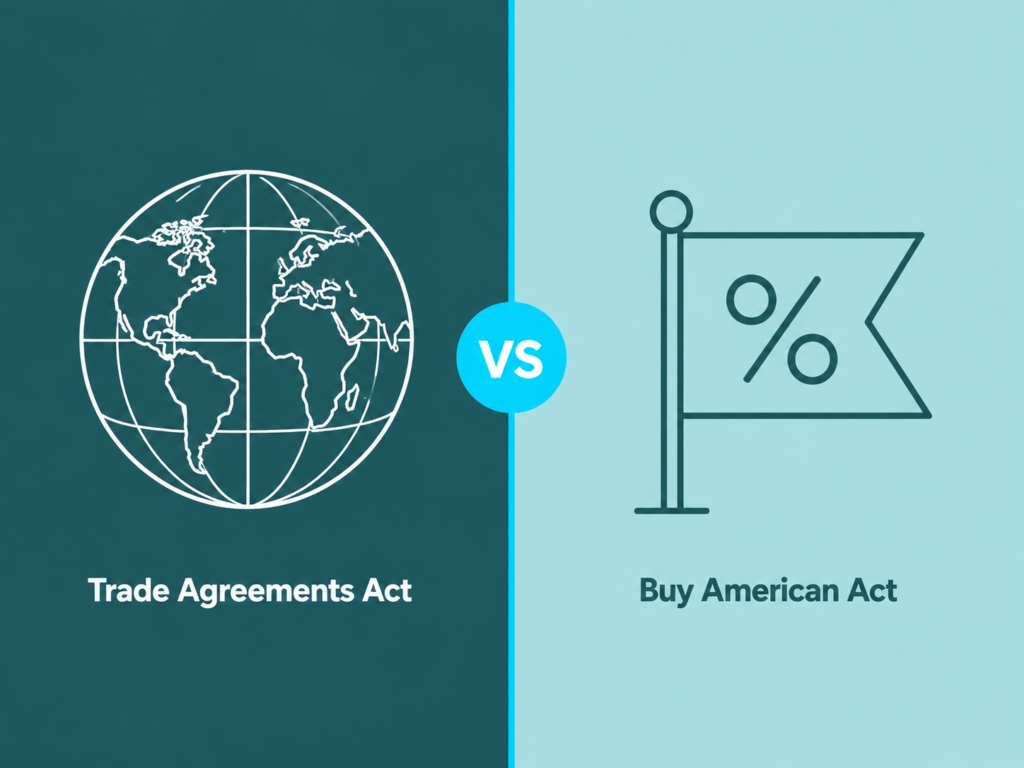
What the Trade Agreements Act Actually Requires
The Trade Agreements Act, codified at 19 U.S.C. 2501 through 2581 and implemented through FAR Subpart 25.4, governs acquisitions covered by trade agreements. GSA Schedule contracts fall under this rule by default, so the TAA clause at FAR 52.225-5 applies to essentially every Schedule item you sell.
TAA compliance is a country of origin standard, not a percentage standard. Your end product must be wholly grown, produced, or manufactured in the United States, or substantially transformed in a TAA-designated country. There is no domestic content math involved.
Every product line on your GSA offer requires TAA certification at the time you submit it, as part of the same offer package covered in our guide on how to get a GSA contract. That certification confirms country of origin for each item, not for your company as a whole.
What the Buy American Act Actually Requires
The Buy American Act, at 41 U.S.C. 8301 through 8305 and FAR Subpart 25.1 and 25.2, works differently. It applies mainly to direct federal procurement not covered by trade agreements, and to construction contracts under related Buy America rules.
Instead of a country list, the Buy American Act uses a domestic content threshold. A minimum percentage of the product’s cost must come from US-made components. That threshold has been rising in phases under recent federal rules, so contractors relying on an older percentage should verify the current figure on acquisition.gov before certifying.
This is the root of the confusion. A GSA contractor who calculates domestic content percentage instead of checking country of origin is applying the wrong law’s math to the right law’s paperwork.

Where GSA Contractors Get This Wrong
Four mistakes account for most of the TAA and Buy American Act confusion we see.
The first is assuming Buy American Act rules apply to a GSA Schedule product, because that is what most contracting guidance online explains by default.
The second is certifying “Buy American compliant” instead of TAA compliant on a GSA offer, which triggers a review delay or rejection.
The third is assuming a product with over half its cost in US components is automatically fine, when TAA cares about country of origin and substantial transformation, not a cost percentage.
The fourth is assuming a country qualifies as TAA-designated because it is a close US trading partner in general, when only countries on GSA’s specific designated list actually qualify.
TAA-Designated Countries and TAA Compliant Countries in 2026
TAA-designated countries fall into a few defined groups: World Trade Organization Government Procurement Agreement parties, Free Trade Agreement countries, Least Developed Countries, and Caribbean Basin countries. A country being a strong US ally does not automatically place it on this list.
This list changes as trade agreements are added or renegotiated, so the safest approach is to check current status before you certify, not rely on memory from a prior contract cycle. For the full, current list of TAA-designated and non-compliant countries, along with how substantial transformation is determined, see our complete TAA compliance guide.

TAA Compliance Exceptions
TAA is not absolute. A handful of exceptions apply.
Acquisitions valued below the applicable trade agreements threshold can fall outside TAA and follow different rules instead. Certain unmanufactured or raw agricultural products are treated differently as well.
Agencies can also grant public interest waivers or nonavailability determinations when no compliant product exists in sufficient quantity or acceptable quality. These exceptions are granted case by case, not assumed, so do not treat them as a default option for a non-compliant product.
How to Certify TAA Compliance Correctly
Certification happens at the SIN and product level, not once for your whole catalog. Every item you add to your GSA Schedule through a later modification needs its own TAA certification, even if your original offer was fully compliant.
Here is the part that catches contractors off guard: a manufacturing location change after award requires re-certification too. If your supplier moves production from a TAA-designated country to one that is not on the list, your existing certification no longer holds, even mid-contract.
Keep documentation on hand for every certification: country of origin records, supplier attestations, and substantial transformation evidence if the product changes form during manufacturing.
How GSA Contract Services Helps
GSA Contract Services has guided more than 250 clients through federal compliance since 1995, with more than a dozen Authorized Negotiators on staff. We check TAA compliance against the correct standard before you certify, not after a contracting officer flags it.
If you are unsure whether your product needs TAA or Buy American Act compliance, or you are adding new SINs and need each one certified correctly, our team handles this as part of our Annual Contract Management Program.
Quick Recap
The Trade Agreements Act and the Buy American Act are separate laws with separate standards. TAA governs GSA Schedule contracts and is based on country of origin and substantial transformation. The Buy American Act governs most other federal procurement and is based on a domestic content percentage. Certify against the correct standard for every product line, verify TAA-designated country status before you rely on it, and know the exceptions before you assume one applies.
Frequently Asked Questions
What is the difference between the Trade Agreements Act and the Buy American Act?
The Trade Agreements Act governs GSA Schedule contracts and is based on country of origin. The Buy American Act governs most other federal procurement and is based on a domestic content percentage. They are separate laws with separate standards.
Does the Buy American Act apply to GSA Schedule contracts?
Rarely. GSA Schedule contracts are subject to trade agreements by default, so the Trade Agreements Act applies instead of the Buy American Act in almost every case.
What are TAA-designated countries?
Countries that fall under the World Trade Organization Government Procurement Agreement, a Free Trade Agreement with the US, the Least Developed Countries list, or the Caribbean Basin countries list. See our full TAA compliance guide for the current list.
What are the exceptions to TAA compliance?
Acquisitions below the applicable trade agreements threshold, certain raw agricultural products, and agency-granted public interest or nonavailability waivers. These are case by case, not automatic.
Ready to Confirm Your TAA Compliance Status?
If you are not sure whether your product needs TAA or Buy American Act certification, our Authorized Negotiators can check it against your specific SIN before you submit. Contact us to get started.
GSA Contract Services, LLC | 4622 Cedar Avenue, Suite 123, Wilmington, NC 28403 | 202-280-7060 | Sales@GSA-CS.com