
By GSA Contract Services, LLC | Reviewed by our Authorized Negotiator team |
Knowing how to grow a small business through a GSA Schedule starts with one fact: the contract lets federal agencies buy from you at pre-negotiated prices without a full competition for every order. The Multiple Award Schedule (MAS) closed FY2025 with $50.6 billion in sales across roughly 14,579 active contractors (GSA SSQ+). Small businesses hold about 80% of those contracts and won 36% of the award dollars (GSA SSQ+).
Holding a contract and selling through it are two different things, however. Below are the four post-award steps we walk clients through on how to grow a small business through a GSA Schedule. We also cover the compliance gaps that removed contractors from the program this year.
Key Takeaways
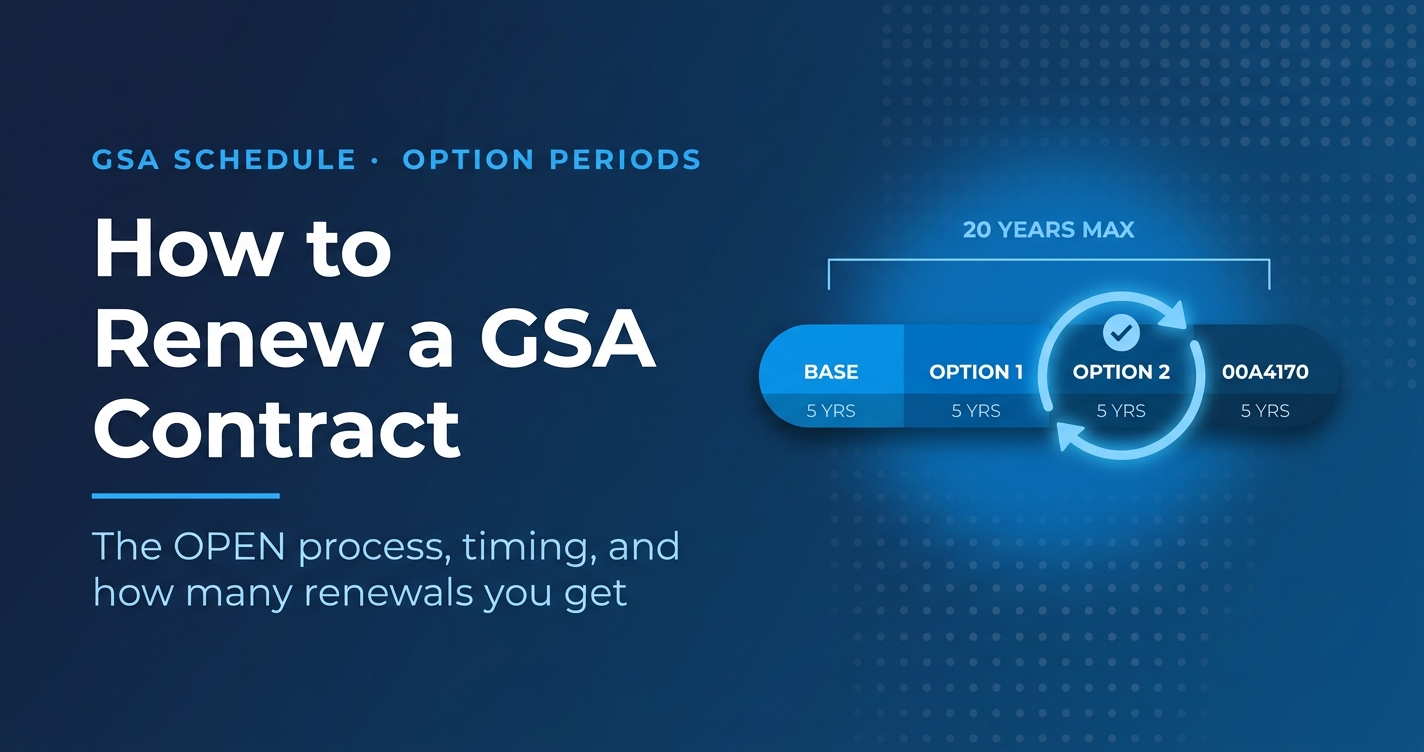
- A GSA Schedule runs up to 20 years: a 5-year base period plus three 5-year options.
- Agencies can order up to $10,000 from any MAS contractor without collecting quotes.
- You must sell at least $100,000 through the Schedule in the first five years to keep it.
- TDR reporting is now mandatory on every SIN. The grace period ends December 31, 2026.
- Growth comes from catalog upkeep, daily eBuy checks, and direct agency outreach, not the award alone.
What Does GSA Stand For, and Why Do GSA Contracts Drive Small Business Growth?
GSA stands for the General Services Administration, the federal agency that buys goods and services on behalf of other agencies. Its MAS program, still called the Federal Supply Schedules by many buyers, is the largest government commercial acquisition program in the world (gsa.gov).
For a small business, the appeal is volume and duration. The federal government awarded $179 billion in prime contracts to small businesses in FY2025. That is about 28% of all prime dollars, against a 23% statutory goal (SBA FY2025 Scorecard). GSA itself earned an A+ on that scorecard, so the agency running the Schedule actively buys from small firms.
The contract structure matters as much as the market size. A Schedule has a 5-year base period and three 5-year options, so a single award can support sales for up to 20 years. That is why we treat it as a sales channel to build, not a one-time bid to win. For the broader case, see why small businesses should consider GSA Schedules.
Where Can You Bid on Government Contracts? SAM.gov Contract Opportunities vs. GSA eBuy
Most first-time vendors start on SAM.gov, where agencies post open-market solicitations. Any registered business can respond. As a result, competition is wide, each response is a full proposal, and every win is a single transaction.
Consider a common case. A federal facilities office needs replacement appliances. Without a Schedule, a supplier waits for a one-off government procurement top load washer and refrigerator bid, writes a proposal, and competes against every registered vendor. With a Schedule, that same office can place an order under $10,000 directly, with no quotes required.
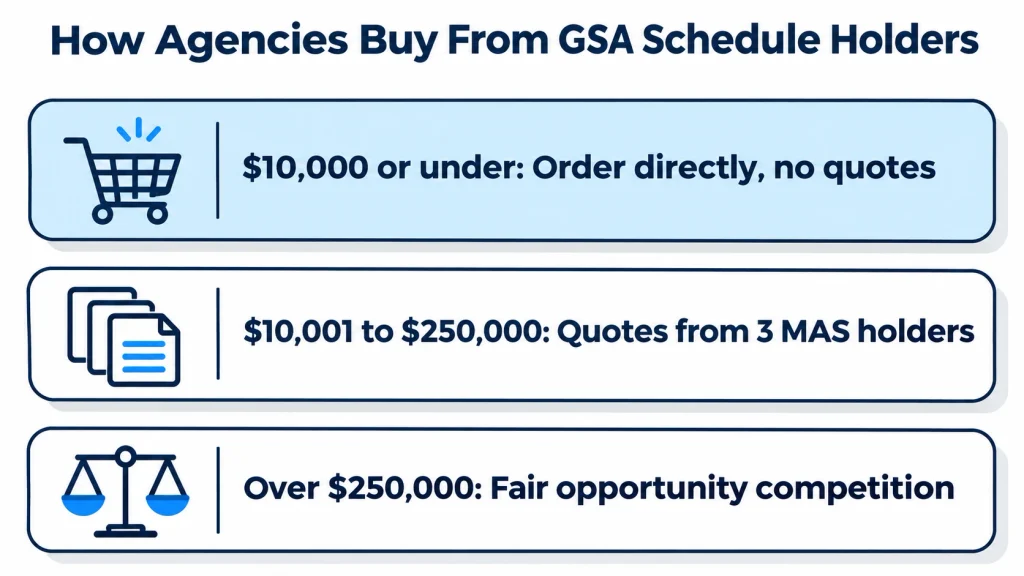
GSA eBuy works differently. It is a request-for-quote platform open only to Schedule holders, so the pool of competitors is smaller from the start. The ordering rules below show how agencies buy once you are on contract.
| Order value | How the agency buys from Schedule holders |
| $10,000 or under | Orders directly from any MAS contractor. No quotes needed. |
| $10,001 to $250,000 | Gets quotes from at least 3 MAS holders. May post the request on GSA eBuy. |
| Over $250,000 | Runs a fair opportunity mini-competition among all relevant MAS holders. |
Source: GSA MAS ordering procedures, 2026 thresholds.
Both routes require an active registration. Our SAM.gov registration service covers the setup and the annual renewal, because a lapsed registration suspends your eligibility for payment.
How to Get on GSA Schedule: Small Business Planning Before You Apply
Getting the award means SAM.gov registration, choosing your SINs, documenting your pricing, and submitting an offer that is compliant with Transactional Data Reporting (TDR). Under Refresh 31, GSA rejects non-TDR offers outright. We cover each stage in detail in a separate post. Click here to get the full guide on how to get on GSA Schedule.
One piece of small business advice belongs here, though, because it decides whether growth is possible at all. Before you spend money applying, confirm you can reach $100,000 in Schedule sales within five years. If you cannot name three agencies that already buy what you sell, a Schedule is the wrong tool for now. Our GSA Schedule contracts team runs that check before any offer goes in.
Find Out If Your Business Qualifies
Our Authorized Negotiators review your products, pricing, and federal demand before you commit to an offer.
Get Your Eligibility Review →A Business Growth Strategy for Your First 12 Months on Schedule
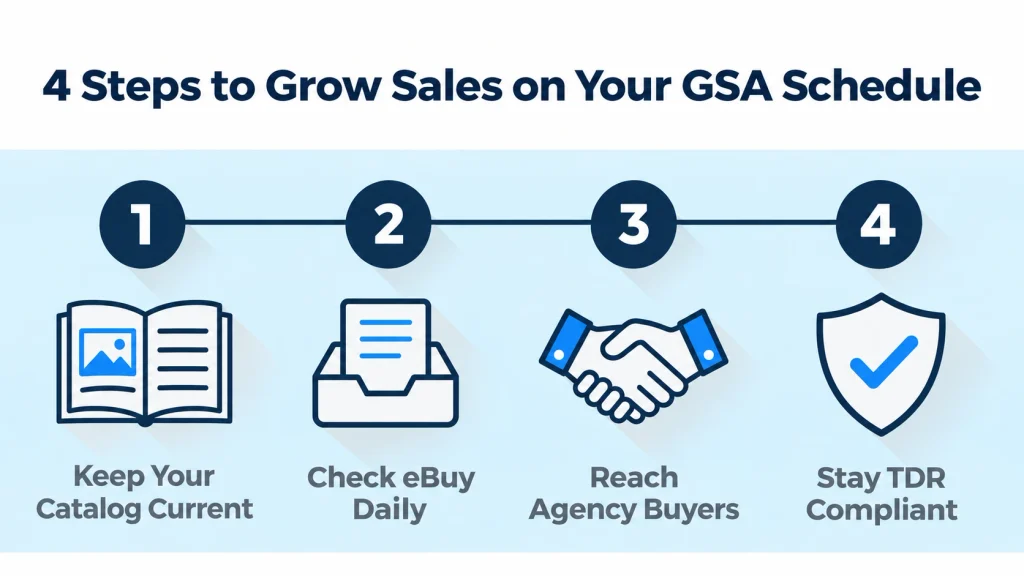
The award is where the selling work starts. These steps separate contractors who reach their minimums from those who do not. They are the practical answer to how to grow a small business through a GSA Schedule once the contract number arrives.
Step 1: Keep your GSA Advantage catalog accurate
Contracting officers skip listings with stale prices or missing product data. In practice, an outdated catalog makes your contract invisible to buyers. Monthly updates are where most teams fall behind, as we explain in why monthly GSA catalog updates become a recurring burden. Large catalogs are easier to maintain through an automated feed, which our EDI and XML catalog services handle.
Step 2: Check GSA eBuy every business day
Requests on eBuy often close within days. Assign one person to review new postings daily and respond to anything inside your SINs. Small, quick wins build the past performance that larger buyers look for.
Step 3: Market directly to likely agency buyers
A Schedule does not sell itself. Contact the program offices you found during your pre-award research, tell them your contract number, and show them the ordering threshold they can use. The SBA GovCon Match tool can help you find additional likely buyers.
Certifications widen the field further. Service-Disabled Veteran-Owned Small Businesses alone received $32.5 billion in prime contracts in FY2025 (SBA, June 2026). If you qualify for SDVOSB, WOSB, HUBZone, or 8(a) status, apply through MySBA Certifications. Pairing a set-aside status with a Schedule is one of the stronger business strategies for growth available to a small firm.
Small Business Management After Award: Compliance That Protects Growth
Step 4: Treat compliance as part of the sales plan
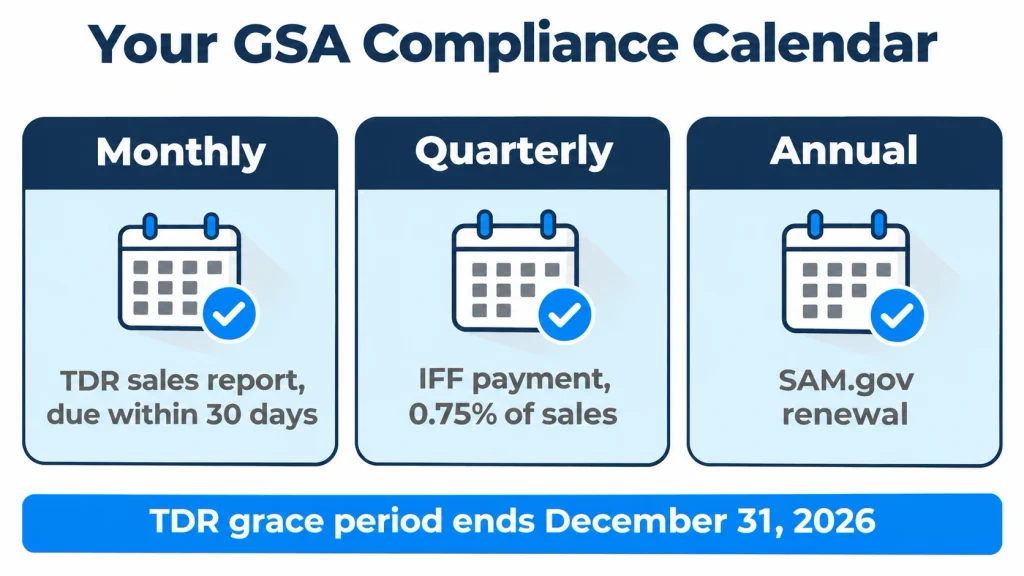
A canceled contract ends every growth plan built on it. Refresh 31 made TDR mandatory on every SIN as of April 2, 2026 (GSA TDR guidance). The grace period ends December 31, 2026, and full enforcement begins January 1, 2027.
| Requirement | Frequency | Current rule |
| TDR sales reporting | Monthly | Due within 30 days after month end through the FAS Sales Reporting Portal |
| IFF payment | Quarterly | 0.75% of MAS sales, due within 30 days after quarter end |
| SAM.gov renewal | Annual | A lapse suspends payment eligibility |
| Minimum sales | Per period | $100,000 in the 5-year base period; $125,000 in each option period |
| Mass modifications | As issued | Accept within the stated window (Refresh 31 allowed 60 days) |
| Price increases | Annual | Maximum 10% per category item unless justified |
Sources: gsa.gov, Vendor Support Center (vsc.gsa.gov).
Most contractors can handle each task alone. The trouble comes from the calendar, with monthly, quarterly, and annual deadlines landing on top of normal operations. Our GSA contract management service tracks those deadlines and files the reports, so your team stays focused on sales.
Is Your TDR Reporting Ready for January 2027?
The Refresh 31 grace period ends December 31, 2026. Have an Authorized Negotiator check your reporting and modification status now.
Get a TDR Compliance Check →Expanding Business on Schedule: Where Most Contractors Stall
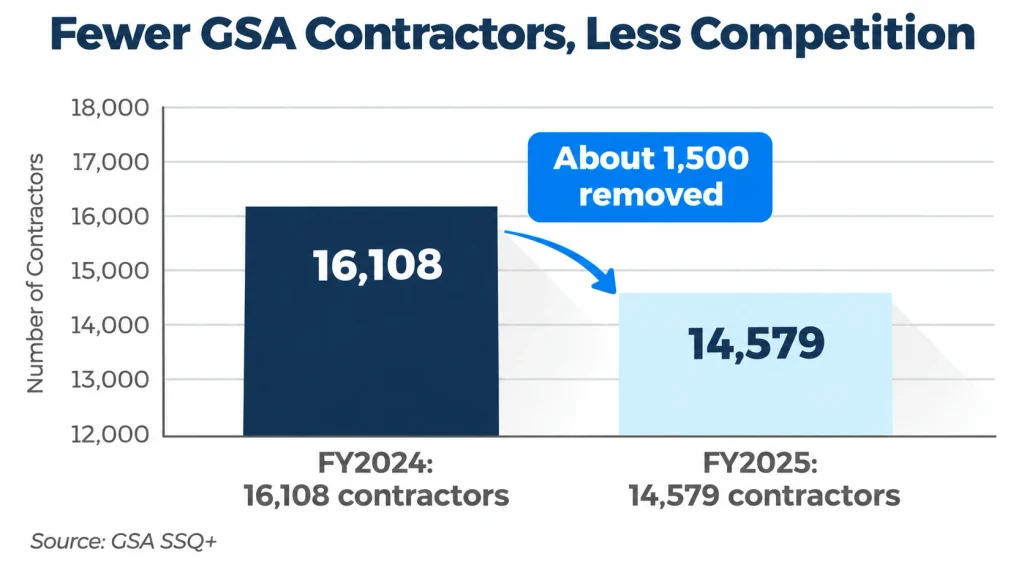
GSA cut its MAS contractor base from 16,108 in FY2024 to about 14,579 in FY2025, roughly 1,500 contracts removed in one year (GSA SSQ+). In our experience, the removed contracts share a few patterns.
- They applied without a buyer in mind, so the contract sat idle and missed the $100,000 base-period minimum that GSA enforces at renewal.
- Their catalog went stale. Prices and product data drifted, and contracting officers moved on to the next listing.
- They ignored mass modifications. Contracts that did not accept the Refresh 31 modification on time now face cancellation.
- They waited until renewal to review sales. GSA starts its renewal review 210 days before expiration. By then, a sales shortfall is hard to close.
Buying patterns also shift. Government agency restructuring and new leadership appointments can move budgets between offices or consolidate purchasing. Contractors who review USAspending.gov each quarter see those shifts early and adjust their outreach before competitors do.
The average figure can mislead, too. MAS sales divided across all contractors works out to about $3.47 million per contractor, but a small number of large vendors pull that average up. Plan around your own pipeline, not the program average.
Business Support From GSA Contract Services
GSA Contract Services has helped companies win and manage Schedules since 1995. We support more than 250 active clients with a team of over a dozen Authorized Negotiators. Our full service list covers each stage covered in this post:
- Preparing and submitting your offer through our Get a GSA Contract service
- Ongoing TDR, IFF, and modification work through GSA contract management
- Processing agency orders through GSA order management
- Catalog uploads to GSA Advantage and FedMall through EDI and XML services
If you are weighing how to grow your business beyond commercial customers, a short review call will tell you whether a Schedule fits your numbers.
Quick Recap: How to Grow a Small Business Through a GSA Schedule
In short, how to grow a small business through a GSA Schedule comes down to four habits:
- Confirm agency demand before you apply, and plan to clear $100,000 in five years.
- Maintain your GSA Advantage catalog and check eBuy daily after award.
- Market directly to agencies and add set-aside certifications where you qualify.
- Meet monthly TDR, quarterly IFF, and modification deadlines without exception.
Frequently Asked Questions About Growing on a GSA Schedule
What does GSA stand for?
GSA stands for the General Services Administration. It runs the Multiple Award Schedule program that federal, and some state and local, buyers use to purchase commercial products and services.
Is a GSA Schedule worth it for a small business?
It is worth it when agencies already buy what you sell and you can reach $100,000 in Schedule sales in the first five years. Without that demand, the contract adds compliance work with no revenue.
Can I add products or services after award?
Yes. You add items or SINs through a contract modification, which is a routine part of managing a Schedule. Adding products buyers already search for is one of the simplest ways to raise Schedule sales.
What does it cost to keep a GSA Schedule active?
You pay the 0.75% Industrial Funding Fee on Schedule sales each quarter. You also need staff time for monthly TDR reports, catalog updates, and mass modifications.
Talk to an Authorized Negotiator
Tell us what you sell and who buys it. We will tell you plainly whether a GSA Schedule fits your growth plan.
Start Your GSA Schedule Review →