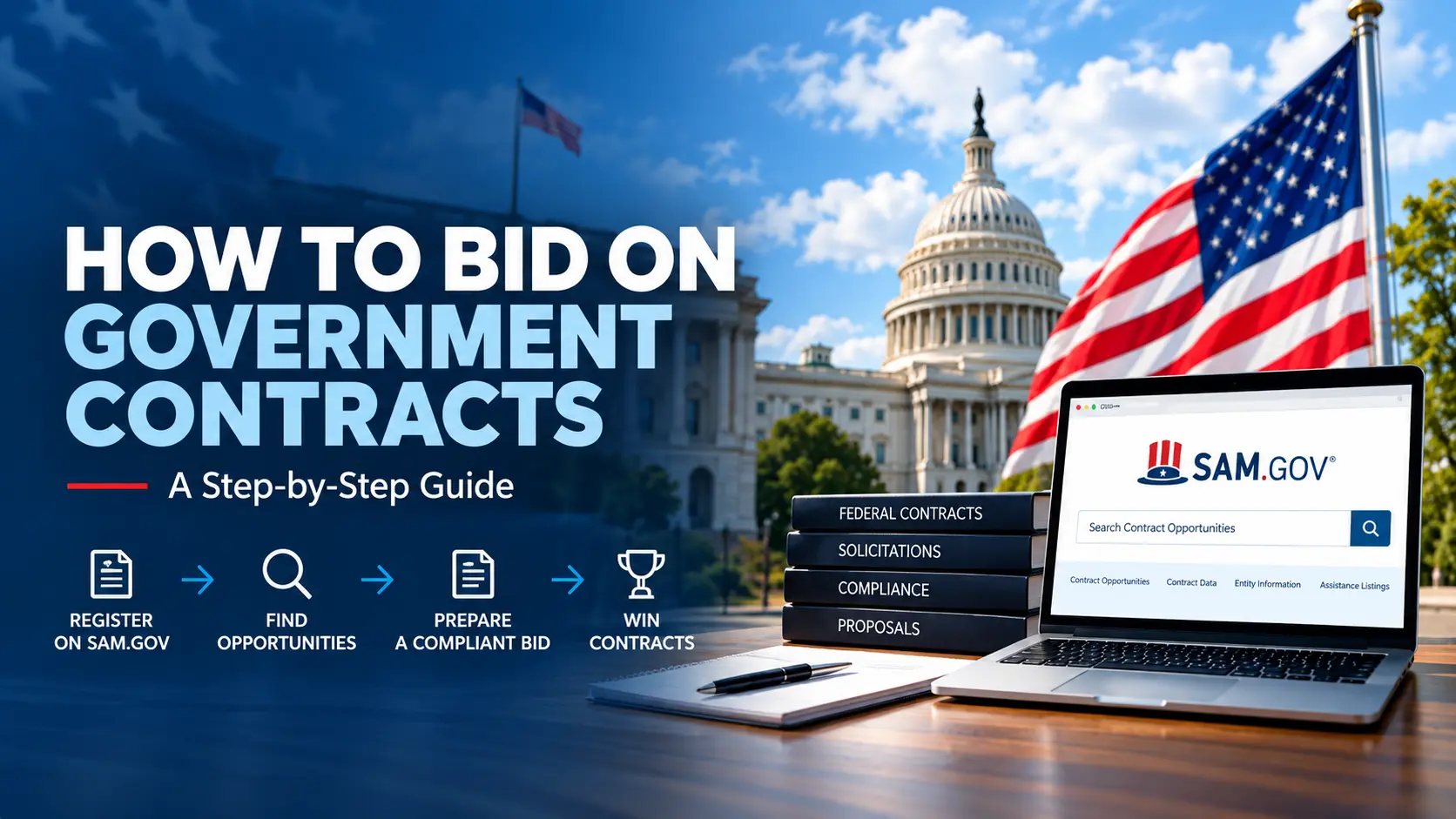
If you want to learn how to bid on government contracts, the first decision is not what price to offer. It is whether the solicitation matches your eligibility, staffing, past performance, and financial capacity. A technically strong proposal can still fail because it ignores an amendment, misses a required attachment, or arrives after the deadline. This guide explains how to complete SAM.gov registration, locate actual solicitations, distinguish requests for information from requests for proposals, build a compliance matrix, price the work, and submit through the agency’s specified channel. It also explains when a small-business set-aside or a GSA Multiple Award Schedule may be relevant. Use the steps below to decide which opportunities merit a bid—and how to respond without relying on assumptions that can disqualify an offer.
Key Takeaways
- SAM.gov registration is free and is usually required for direct federal awards; registration itself does not win contracts.
- Read the entire solicitation and amendments before estimating price or writing the technical narrative.
- A bid/no-bid screen should cover eligibility, past performance, resources, funding, profitability, and deadline feasibility.
- Agencies evaluate according to the published solicitation; lowest price is not universally the deciding factor.
- GSA Schedule orders and open-market solicitations are different acquisition routes, with different competition and submission procedures.
Start Your Government Contract Today
Our consultants prepare and submit your GSA Schedule offer so you can stay focused on running your business.
Start Your GSA Schedule →1. How to Become a Government Contractor: Get the Registration Right
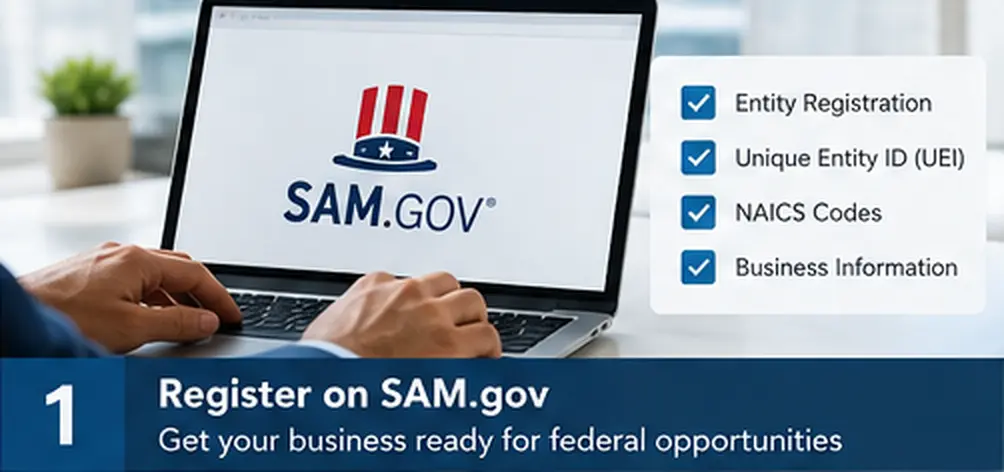
Start with SAM.gov entity registration. Gather your legal business identity, taxpayer information, banking details, ownership information, and applicable NAICS codes. During registration, the government assigns a Unique Entity ID (UEI); a domestic entity needing a CAGE code will generally receive one through the applicable validation process. Keep the registration active and renew it on schedule. A UEI by itself is not equivalent to an active entity registration.
For new vendors, mismatched legal names, taxpayer data, or addresses can delay validation. Choose NAICS codes that describe your actual work, but remember the agency specifies the NAICS code and size standard for each solicitation. If you want a primer on unfamiliar terms such as UEI, CAGE, RFQ and SIN, see our previous blog, Government Contracting Acronyms: A Glossary for GSA Contractors.
2. SAM.gov Government Contracts: Find Solicitations, Not Just Notices
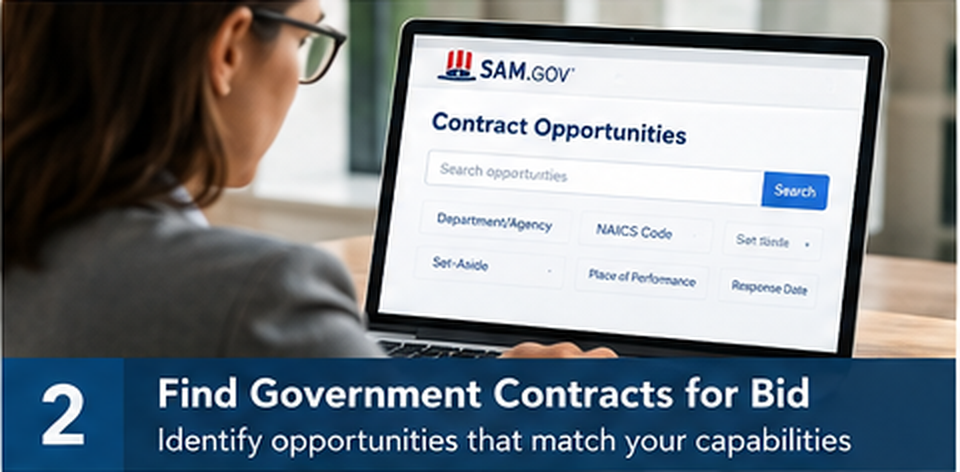
Search SAM.gov Contract Opportunities by NAICS, agency, set-aside, location, response date, and product or service terms. Companies seeking government contracts for bid should verify the notice type before assigning proposal resources. A Sources Sought notice is market research; a presolicitation signals a potential future competition; an RFP, RFQ, or IFB may request an actual offer under different procedures.
| Notice | What it means | Action |
| Sources Sought / RFI | Market research, not necessarily an offer request | Provide capability information if requested |
| Presolicitation | Advance notice of a potential procurement | Track the solicitation release |
| RFQ / RFP / IFB | Formal request governed by its terms | Follow the stated offer and submission instructions |
People searching for fed biz opps should know that the former FBO.gov opportunity service was retired and federal opportunity listings moved to SAM.gov. Search results for “sam government contracts” or “sam.gov government contracts” should ultimately be checked against the official record and attachments, not a third-party excerpt.
3. Government Bids: Make a Bid/No-Bid Decision
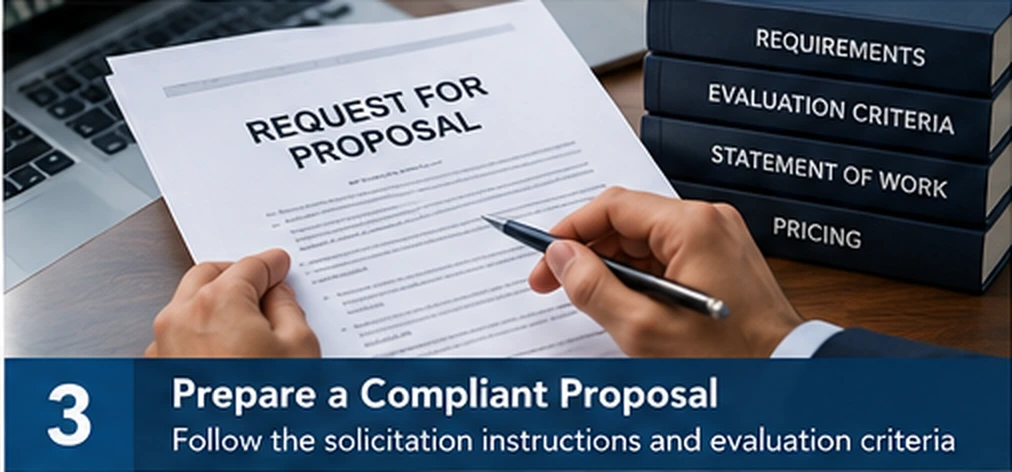
Before spending days writing a proposal, determine whether your company can actually perform. Review the assigned NAICS size standard and any set-aside restrictions; licenses, clearances, or certifications; relevant delivery experience; subcontractor commitments; bonding and insurance; and the working capital needed before payment. Check whether the agency requires experience as a prime contractor or will assess comparable commercial work.
A practical bid/no-bid example
Suppose a 12-person managed IT firm finds two federal contracts: a nationwide, 24/7 security operations requirement calling for cleared staff, and a regional help-desk requirement that permits commercial references. The second may be the better investment even if its contract ceiling is smaller. The first opportunity carries staffing and performance risk that cannot be solved by a low price.
If your firm is still selecting its first targets, you can see our previous blog, What Are the Easiest Government Contracts to Get?, for a closer look at accessible entry points and subcontracting options.
4. How to Bid on Government Contracts: Read, Map and Answer Every Requirement
Read the complete acquisition package
Download the latest solicitation, all amendments, pricing attachments, statement or performance work statement, question-and-answer files, and applicable clauses. Many negotiated federal acquisitions use Section L for offer instructions and Section M for award evaluation factors; not every solicitation uses that format. The actual documents govern.
Build a proposal compliance matrix
Create a row for every mandatory requirement, with its exact source, owner, deadline, and response location. Include page limits, signed forms, representations, price schedules, minimum qualifications, technical narratives, key personnel, past performance references, and amendment acknowledgments.
| Requirement | Evidence or response | Proposed location |
| Key personnel qualifications | Resumes and credential evidence | Technical volume |
| Relevant experience | Project summaries with measurable results | Past-performance volume |
| Service levels / response times | Coverage, escalation and measurement plan | Technical volume |
| CLIN pricing | Completed agency spreadsheet | Price volume |
| Amendment acknowledgment | Required signed form or stated method | Administrative volume |
Write directly to the evaluation criteria
A claim that your team provides “excellent support” does not demonstrate compliance with a four-hour on-site response requirement. Identify service coverage, dispatch location, staffing assumptions, escalation path, and evidence the agency can evaluate. Make assumptions explicit where allowed and do not silently qualify a mandatory requirement.
Price for performance, not just award
Account for labor, fringe benefits, overhead, material, travel, subcontractors, escalation, insurance, compliance cost, and profit. Evaluate option periods separately when requested. The agency may evaluate price reasonableness, price realism, or other pricing elements according to the solicitation and applicable rules.
Submit through the specified method
Do not assume all bids are uploaded to SAM.gov. The solicitation may specify an agency portal, a procurement platform or an email inbox. Confirm the closing time zone, permitted file types, maximum file sizes and receipt rules well before the deadline. Late offers may be rejected even when the proposal itself is strong.
5. Government Contracts for Small Businesses: Use Set-Asides Correctly
Small-business set-asides can limit eligible competitors, but they are not shortcuts around technical requirements. Common categories include total small business, 8(a), HUBZone, women-owned small business (WOSB), economically disadvantaged WOSB, and service-disabled veteran-owned small business (SDVOSB). Check the SBA contracting guidance and the specific certification rules; status and eligibility are program-specific.
If you are comparing how to get government contracts through open solicitations versus other routes, our earlier article, How to Get Government Contracts for Small Business: A Step-by-Step Guide, expands on registration, certifications, and first-award planning.
6. DoD Contracts and Department of Defense Contracts: Additional Checks
The Department of Defense buys commercial products, IT services, construction, logistics, manufacturing, research and specialized systems. Some department of defense contracts involve agency-specific portals, procurement security requirements, controlled technical information, or additional clauses under DFARS. Start with the public solicitation and verify the relevant DoD acquisition system and instructions for that procurement.
For government weapons contracts or controlled defense products, check licensing, export controls, technical-data access and product-specific obligations before offering. Ordinary SAM.gov registration alone does not establish permission to supply regulated items. Do not represent your company as cleared or licensed unless that status is current and substantiated.
7. Federal Contractors: Understand How Agencies Select an Offer
Federal contractors should never assume that the lowest number wins. Sealed bidding generally emphasizes responsiveness, responsibility and evaluated price. Negotiated acquisitions may use lowest-price technically acceptable criteria or a tradeoff in which documented technical advantages justify a higher price. The published evaluation method controls. Consult Acquisition.gov and the solicitation’s actual provisions when building your response.
Federal government contractors with no prior prime awards may still be able to compete where solicitation requirements permit commercial past performance or subcontracting experience. Describe each project accurately; never imply a commercial project was a federal prime award.
8. Federal Contracts and GSA Schedule Orders: Know the Difference
You do not need a GSA Schedule to compete for many open-market federal contracts. A GSA Multiple Award Schedule is a separately awarded contract vehicle through which eligible agencies can purchase covered products and services under applicable ordering rules. Holding one does not guarantee a sale, eliminate order-level competition or replace your responsibility to comply with each requirement.
If you want to evaluate whether your catalog or services fit this route, see our previous blog, Why Small Businesses Should Consider GSA Schedules. For businesses comparing Schedule categories, our guide to choosing the right GSA Special Item Numbers explains why SIN selection matters before submitting an offer.
9. Federal Contracting Updates: Monitor Amendments Until Award
An initial download is not enough. During bidding on government contracts, track solicitation amendments, Q&A releases, attachment replacements, deadline changes and new agency instructions. Assign one person to check the official notice record daily during an active pursuit and distribute changes to pricing, technical and executive reviewers.
Maintain a simple pursuit log: solicitation ID; buying office; NAICS; set-aside; deadline and time zone; compliance owners; amendments reviewed; bid/no-bid decision; price approval; submission evidence; and award outcome. This makes proposal lessons measurable rather than anecdotal.
10. Common Reasons Government Proposals Fail
- A qualified company bids on a contract it cannot staff or finance.
- The proposal answers a general statement of work but not the solicitation’s rated factors.
- A mandatory document or amendment acknowledgment is omitted.
- Pricing excludes travel, option years or material costs.
- The company relies on outdated requirements or assumes a deadline extension.
- A proposal is submitted to the wrong portal or after the receipt cutoff.
If you regularly review a list of government contracts, measure the percentage that are truly bid-worthy and the causes of each lost pursuit. Better qualification is often more useful than simply increasing the number of submissions.
11. How GSA Contract Services Fits Into the Process
GSA Contract Services is an independent consulting firm, not a government agency. Its services include SAM.gov registration support and GSA Multiple Award Schedule acquisition and management. Businesses can pursue open-market agency solicitations without hiring a consultant or holding a Schedule. A firm exploring the Schedule route should separately assess eligibility, documented commercial sales, product or service fit, required offer documents and post-award reporting.
To understand the Schedule acquisition process before committing resources, review GSA Schedule Contract Acquisition Services and the related guidance on our GSA-CS blog. Neither registration nor a Schedule award guarantees government orders.
Still Have a Question? Ask Us
Tell us where you are in the GSA Schedule process and a consultant will get back to you with a clear answer.
Ask Your Question →Frequently Asked Questions
Do I need a GSA Schedule to bid on federal opportunities?
No. Many agencies issue solicitations open to eligible businesses that do not hold a GSA Schedule. An agency may also procure using established contract vehicles; always check who is eligible to compete.
Is SAM.gov registration free?
Yes. The federal government does not charge to register or renew an entity on SAM.gov. Third-party assistance is optional.
Can a new company win without federal past performance?
Possibly. Follow the individual solicitation’s experience criteria. Commercial references, relevant staff experience or subcontracting history may be useful when allowed, but never substitute unsupported claims.
Are government contract jobs the same as a contract award?
No. Government contract jobs are employment positions supporting contracted work; a federal contract award is an agreement between the government and a legal contractor.
Where can I view a list of government contracts?
Use SAM.gov Contract Opportunities for public notices and official federal award data sources for research on previously awarded contracts. A search-results page is not a substitute for the current solicitation package.
Final Thoughts
The strongest approach to how to bid on government contracts is selective: verify registration, screen the opportunity, follow the current solicitation, document compliance, build sustainable pricing, and submit correctly. Small businesses can compete successfully without bidding on everything. The objective is not a high proposal count; it is an offer the agency can evaluate and a contract your team can perform.
Editorial verification: Updated October 29, 2026. Review live solicitation instructions, SBA eligibility criteria, and the current FAR/agency supplements before submitting. GSA Contract Services, LLC is a private firm and is not affiliated with or endorsed by the U.S. General Services Administration.