
A GSA Schedule compliance audit is a review of your contract records to confirm that your pricing, sales reporting, fees and catalog match the terms of your Multiple Award Schedule contract. For most contractors, that review arrives as a GSA contractor assessment led by an Industrial Operations Analyst (IOA). The firms that come through cleanly are the ones whose records were in order before the IOA called. This guide covers what reviewers check, which records to organize, and the mistakes that turn a routine review into a list of findings.
Key Takeaways
- A GSA Schedule compliance audit most often takes the form of a GSA contractor assessment led by an IOA.
- The Contractor Assessment Report goes to you and your Contracting Officer at the same time.
- Under GSAR 552.238-83, GSA can examine your records until 3 years after final payment.
- TDR is mandatory on every SIN, and full enforcement begins January 1, 2027.
- Reconcile TDR reports, IFF payments and pricing before the IOA asks for them.
Why GSA audit preparation matters more in 2026
On October 21, 2026, GSA and the SBA announced that federal contracts held by 689 firms suspended from the 8(a) Business Development Program are being audited for potential fraud (GSA, October 2026). GSA will refer suspected fraud to the Office of Inspector General and the Department of Justice.
That review targets a specific group of suspended firms. Still, it confirms a pattern every Schedule holder should notice: GSA is looking at contracts after award, not only when an offer is evaluated.
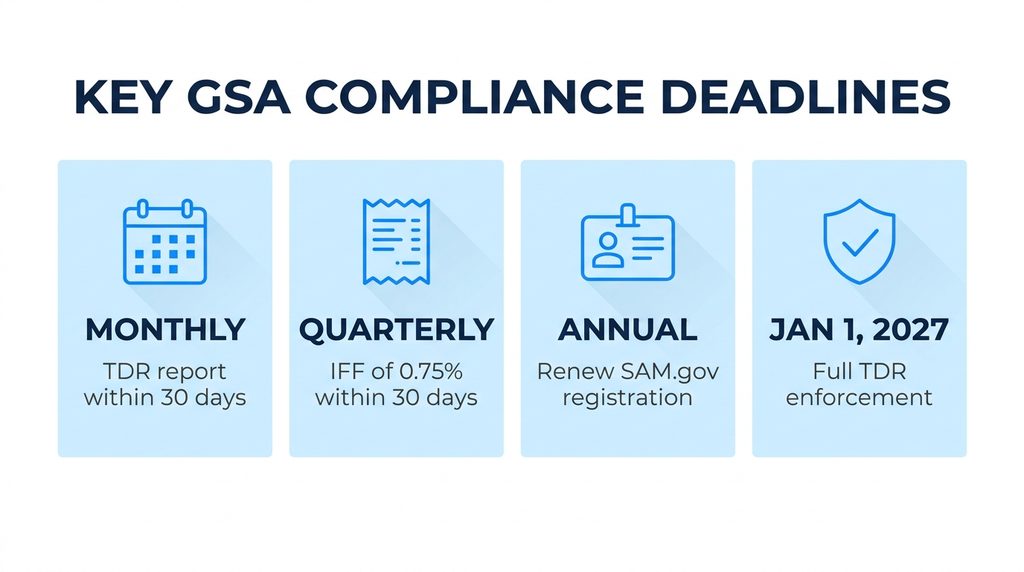
The contractor base is also shrinking. Active MAS contractors fell from 16,108 in FY2024 to approximately 14,579 in FY2025, roughly 1,500 contracts removed in a single year (GSA SSQ+). In addition, Transactional Data Reporting (TDR) became mandatory on every SIN on April 2, 2026, through Refresh 31. Full enforcement begins January 1, 2027 (gsa.gov).
In short, MAS contract compliance is now checked more often and with less tolerance for gaps. Knowing who reviews your contract, and how, is the first step toward a clean GSA Schedule compliance audit.
GSA contractor assessment vs. OIG audit: what is the difference
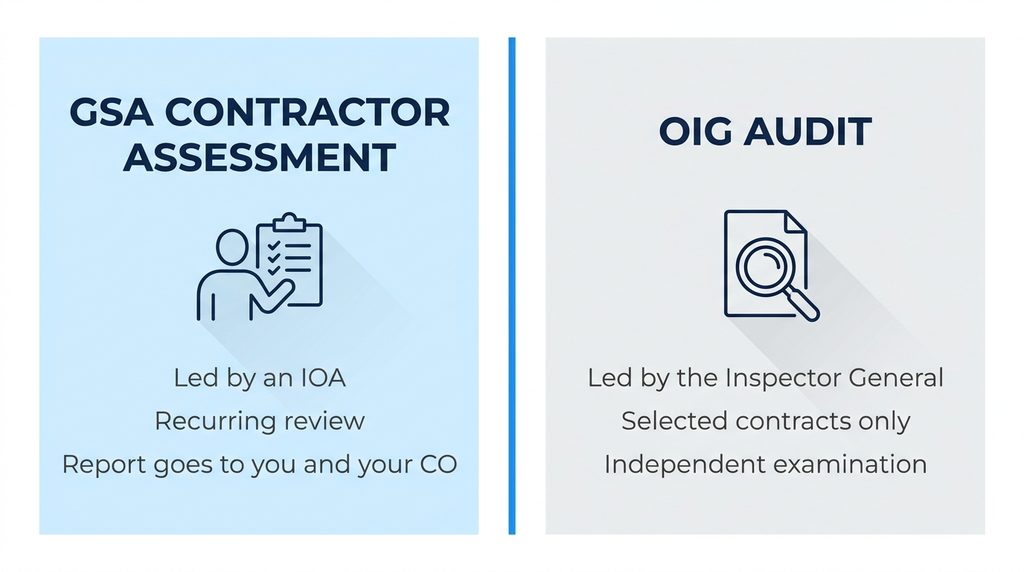
Most Schedule holders will never face an Inspector General audit. Nearly all of them, however, will go through a GSA contractor assessment. GSA describes the assessment as a review of your records to verify contractual compliance, and the frequency depends on factors that include sales volume (Vendor Support Center).
After the review, the IOA records the findings in a Contractor Assessment Report (CAR). You and your Contracting Officer receive the CAR at the same time, so anything it flags is visible to the person who administers your contract.
| Feature | GSA contractor assessment | OIG audit |
| Who conducts it | GSA Industrial Operations Analyst | GSA Office of Inspector General |
| Purpose | Verify compliance with key contract clauses and help the contractor stay compliant | Independent examination, often of pricing, billing or suspected misconduct |
| How often | Recurring; frequency depends on factors such as sales volume | Selected contracts only |
| Types | Annual assessment and end of term assessment | Pre-award or post-award |
| Output | Contractor Assessment Report, shared with you and the CO | Audit report with findings and recommendations |
GSA’s right to see your records also lasts longer than many contractors assume. Under GSAR 552.238-83, GSA may examine records tied to your contract for overbillings, billing errors, and Industrial Funding Fee and sales reporting compliance. That authority runs until 3 years after final payment, and the base period and each option are treated as separate contracts (acquisition.gov). As a result, records from an earlier option period can still be requested.
Not Sure Where Your Contract Stands?
We review your GSA Schedule records against the same compliance areas an IOA checks, so you can fix gaps before the assessment.
Get Your Contract Reviewed →What reviewers check: GSA Schedule compliance requirements
Before a GSA contractor assessment, the IOA sends a list of the documents they want to see. The areas below come up most often, so treat this table as your GSA audit checklist.
| Compliance area | What the reviewer checks | Rule or source |
| TDR sales reporting | Monthly reports filed within 30 days after month end, with totals that match your invoices | FAS Sales Reporting Portal; Refresh 31 |
| Industrial Funding Fee | 0.75% of Schedule sales, paid within 30 days after each quarter ends | Vendor Support Center |
| Pricing | Prices charged match awarded prices; increases stay within the 10% per item per year cap | MAS contract terms |
| Minimum sales | $100,000 in the first 5 years; $125,000 in each 5-year option period | Clause I-FSS-639 |
| Catalog | Current pricing and product data on GSA Advantage | GSA Advantage |
| Contract scope | Only awarded items, SINs and labor categories sold under the Schedule | MAS contract terms |
| Country of origin | Products come from the U.S. or a designated country | Trade Agreements Act; FAR 52.225-5 |
| Registration | Active SAM.gov registration with accurate representations and certifications | SAM.gov |
| Mass modifications | Accepted within the required window (Refresh 31 allowed 60 days) | GSA Interact |
Each row is a separate set of records. Most of the GSA Schedule compliance requirements above are routine on their own; the problems start when several drift at once.
7 steps for GSA audit preparation
If you are working out how to prepare for a GSA audit, start with the records the IOA is most likely to request. These seven steps follow the order we use with clients.
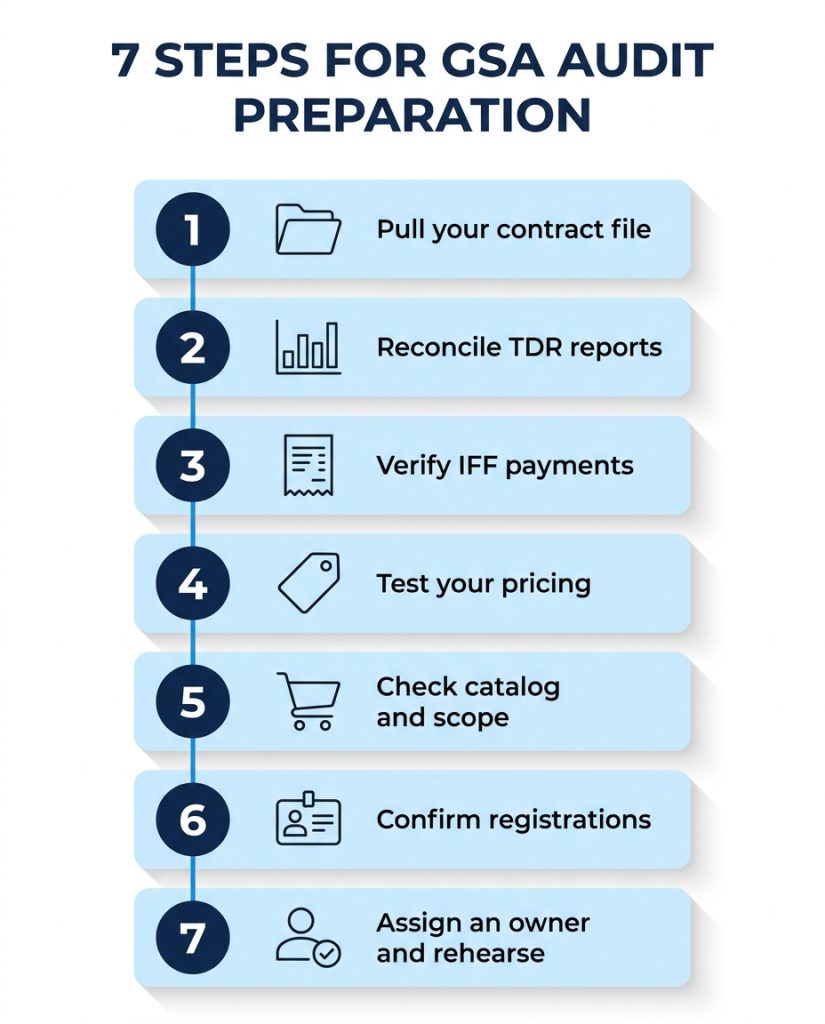
1. Pull your complete contract file
Gather the current contract, every modification, and your awarded price list. Confirm that each mass modification was accepted, including Mass Mod A909 for TDR under Refresh 31. A missing modification is one of the first gaps an IOA notices.
2. Reconcile TDR reports against invoices
Check that every month has a report filed in the FAS Sales Reporting Portal and that each total matches your invoices to federal customers. The TDR grace period ends December 31, 2026, so any gaps should be closed before then.
3. Verify your Industrial Funding Fee payments
The fee is 0.75% of MAS sales and is due within 30 days after each quarter ends (vsc.gsa.gov). Match each remittance to the sales you reported for that quarter. Underpaid fees are easy for reviewers to calculate and slow to explain.
4. Test your pricing against the awarded price list
Pull a sample of recent invoices and compare each line to your awarded prices. Under GSAR 552.238-83, overbillings and billing errors fall within GSA’s right to examine your records, so fix any discrepancy you find and document the fix.
5. Check your catalog and contract scope
Make sure your GSA Advantage catalog shows current prices and products. Then confirm that nothing sold under the Schedule falls outside your awarded SINs or labor categories. For products, keep country-of-origin records that support Trade Agreements Act compliance under FAR 52.225-5.
6. Confirm registrations and socioeconomic status
Your SAM.gov registration must be renewed every year, and a lapse can suspend payment eligibility. If you claim small business, 8(a) or another socioeconomic status, keep your eligibility documents current through MySBA Certifications. On set-aside orders, track your subcontracting percentages against the limits in FAR 52.219-14.
7. Assign one owner and rehearse
Name one person who owns MAS contract compliance and the document list. Walk through the IOA’s request before the meeting, and confirm which authorized negotiators will attend. A short rehearsal surfaces missing files while there is still time to find them.
Want a Second Set of Eyes on Your Records?
We help Schedule holders reconcile TDR reports, IFF payments and pricing before GSA asks for them.
Request an Audit Readiness Review →Common MAS contract compliance mistakes
The issues below come up repeatedly in our GSA contract management work. None of them is unusual, and each is easier to fix before an assessment than after one.
Treating sales reporting as a year-end task. Monthly TDR reports that are filed late tend to pile up. By the time someone reconciles them, the totals no longer match the invoices.
Losing track of mass modifications. Contracts that did not accept Mass Mod A909 by June 2, 2026 face cancellation. Refresh 31 allowed 60 days to accept instead of the usual 90, and several contractors missed the shorter window.
Letting the catalog go stale. Contracting officers skip listings with outdated pricing or missing product data. An outdated GSA Advantage catalog is also a common assessment finding.
Selling outside the contract. Adding an unawarded item to a Schedule order is a scope problem, even if the price is fair. File a modification first.
Ignoring low sales until renewal. Contracts that do not reach $100,000 in base period sales are not being renewed. An end of term assessment is a poor time to discover the shortfall.
How GSA Contract Services helps with GSA contractor assessment readiness
GSA Contract Services has managed GSA Schedules since 1995. Our team of more than 12 Authorized Negotiators supports over 250 active clients. For GSA audit preparation, that work typically includes:
- Ongoing GSA contract management, including TDR reporting and IFF tracking
- Preparation for the GSA contractor assessment and the end of term review
- GSA audit support when the IOA or another reviewer requests records
- Contract modifications to add products, update pricing or accept mass modifications
- GSA Advantage catalog updates through EDI
See our full list of GSA services, or contact us to talk about your contract.
GSA Schedule compliance audit FAQs
How often does GSA conduct a contractor assessment?
GSA sets the frequency based on factors that include sales volume. Assessments include annual reviews and an end of term review near the end of a contract period (Contractor Assessment Reference Guide).
Is a GSA contractor assessment the same as an audit?
No. An IOA conducts the assessment to verify compliance with key contract clauses. An OIG audit is a separate, independent examination. GSA’s reference guide explains the differences between the two.
How long should I keep GSA contract records?
GSAR 552.238-83 gives GSA access to contract records until 3 years after final payment, with the base period and each option treated separately. Keep sales, invoice, IFF and pricing records for at least that long.
What happens if the assessment finds problems?
The IOA documents findings in the Contractor Assessment Report, which your Contracting Officer receives at the same time you do. Address each finding promptly and keep records of the fix. Unresolved findings carry into future reviews of the contract.
Get ready for your next review
A GSA Schedule compliance audit rewards contractors who keep their records current all year. If you are unsure whether your reporting, fees or catalog would hold up, a review now costs far less than corrective action later.
Get Ready for Your Next GSA Contractor Assessment
Talk to a GSA Contract Services Authorized Negotiator about your contract file, reporting and catalog.
Get Your Contract Audit-Ready →GSA Contract Services, LLC | Serving GSA Schedule contractors since 1995 | 4622 Cedar Avenue, Suite 123, Wilmington, NC 28403 | 202-280-7060 | Sales@GSA-CS.com