
Government contracting acronyms are the shorthand that agencies, contracting officers, and vendors use for federal rules, programs, and systems. A single GSA solicitation refresh can contain dozens of them, and each one ties to a deadline, a fee, or a clause in your contract. This glossary defines the terms GSA Schedule holders actually see. We group them by where you meet them: the Schedule itself, compliance, registration, set-asides, and ordering. If you are still learning how a GSA contract works, start there and keep this page open as a reference.
Key Takeaways
- •Refresh 31 made TDR mandatory on every SIN as of April 2, 2026, and removed the PRC and CSP-1. Older glossaries still list rules that no longer apply.
- •Contracts that did not accept Mass Mod A909 face cancellation. Full enforcement begins January 1, 2027.
- •TDR is due within 30 days after each month ends. The 0.75% IFF is due within 30 days after each quarter ends.
- •SAM.gov registration is free but expires every year. A lapse suspends payment, even on orders you already delivered.
- •Agencies can order up to $10,000 from any MAS holder with no quotes, so a stale GSA Advantage catalog costs you sales.
- •Set-aside status only helps if it is current in your SAM representations and certifications.
Table of Contents
Why govcon terminology matters more after Refresh 31
Federal contracting vocabulary shifted in 2026, and many older glossaries have not caught up. As of April 2, 2026, Transactional Data Reporting (TDR) became mandatory for every GSA Schedule contract on every Special Item Number through Refresh 31 (gsa.gov). The same refresh eliminated the Price Reductions Clause (PRC). It also dropped the Commercial Sales Practices (CSP-1) requirement.
As a result, two acronyms that many contractors learned first now describe rules that no longer apply to MAS offers. Meanwhile, TDR and Mass Mod A909 carry live deadlines. The grace period ends December 31, 2026, and full enforcement begins January 1, 2027 (GSA Interact).
The cost of misreading these terms is measurable. GSA’s MAS contractor base fell from 16,108 in FY2024 to approximately 14,579 in FY2025, roughly 1,500 contracts removed in one year (GSA SSQ+). Missed reporting and unmet sales minimums drive most of those removals. Knowing the vocabulary is the first defense against both.
What are 20 acronyms every GSA contractor should know?
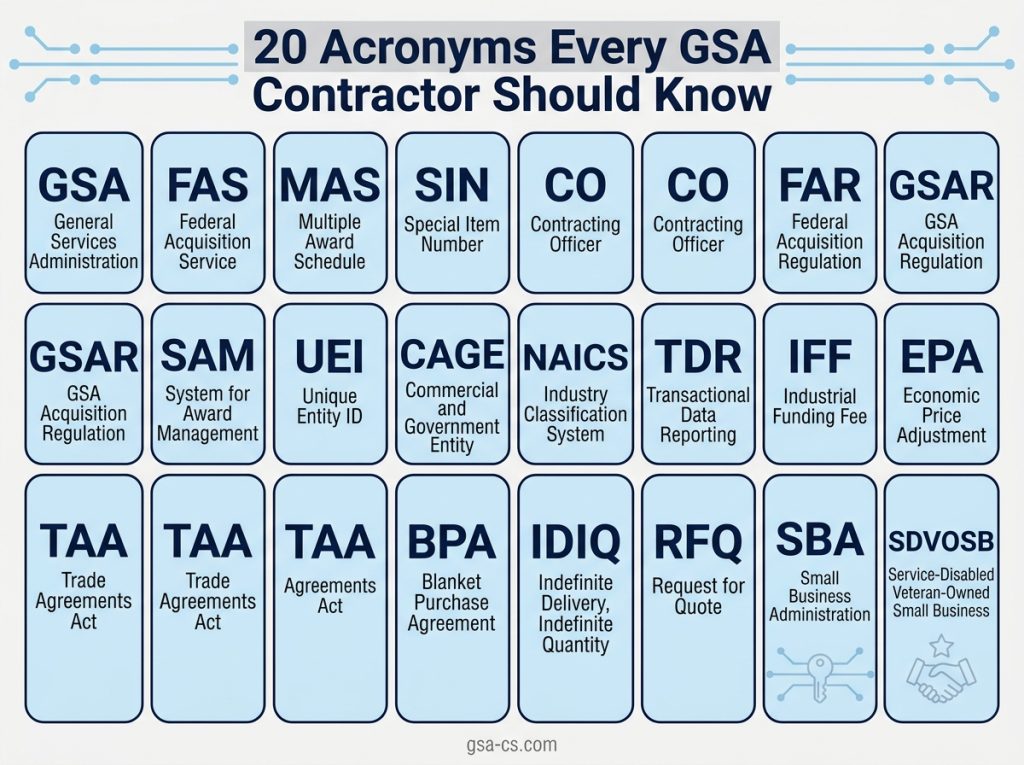
If you keep one contract abbreviation list at your desk, make it this one. These 20 terms appear in nearly every Schedule offer, modification, and order.
| Acronym | Stands for | Why it matters to you |
| GSA | General Services Administration | The federal agency that runs the MAS program |
| FAS | Federal Acquisition Service | The GSA division that manages your Schedule |
| MAS | Multiple Award Schedule | Your contract vehicle with the federal government |
| SIN | Special Item Number | The category your products or services are listed under |
| CO | Contracting Officer | The only official who can change your contract terms |
| FAR | Federal Acquisition Regulation | The core rulebook for federal purchasing |
| GSAR | GSA Acquisition Regulation | GSA’s supplement to the FAR |
| SAM | System for Award Management | Mandatory registration before any federal award |
| UEI | Unique Entity ID | Your federal identifier, assigned in SAM |
| CAGE | Commercial and Government Entity code | A facility code assigned during SAM registration |
| NAICS | North American Industry Classification System | Codes that define your industry and size standard |
| TDR | Transactional Data Reporting | Monthly sales reporting, now required on every SIN |
| IFF | Industrial Funding Fee | 0.75% of Schedule sales, paid quarterly |
| EPA | Economic Price Adjustment | The modification used to change contract prices |
| TAA | Trade Agreements Act | Country-of-origin rule for Schedule products |
| BPA | Blanket Purchase Agreement | An agency agreement for repeat orders off your Schedule |
| IDIQ | Indefinite Delivery, Indefinite Quantity | The contract structure MAS uses |
| RFQ | Request for Quote | How agencies collect pricing, often through eBuy |
| SBA | Small Business Administration | Certifies set-aside status and tracks agency goals |
| SDVOSB | Service-Disabled Veteran-Owned Small Business | A set-aside category with its own SBA certification |
The sections below go deeper on each group, with the details that matter once you hold a contract.
GSA schedule acronyms and MAS contract terms
These terms describe the contract itself. The Multiple Award Schedule is the largest government commercial acquisition program in the world (GSA Multiple Award Schedule). It closed FY2025 with $50.6 billion in sales across more than 300 SINs (GSA SSQ+).
| Term | Meaning | What to know |
| MAS | Multiple Award Schedule | One contract replaced the old category-by-category Schedules |
| FSS | Federal Supply Schedule | The older program name; VA still runs its own FSS contracts |
| SIN | Special Item Number | Adding a SIN later is a modification, not a new contract |
| CO / ACO / COR | Contracting Officer / Administrative CO / CO’s Representative | A COR monitors performance but cannot authorize a contract change |
| EPA | Economic Price Adjustment | Increases are capped at 10% per category item per year unless justified |
| MFC | Most Favored Customer | The commercial customer who receives your best price |
| eOffer / eMod | GSA’s offer and modification portals | Where you submit your offer and every later change |
| FCP | FAS Catalog Platform | Where your product and pricing data is managed for GSA Advantage |
| Mass Mod | A modification GSA issues to all contracts at once | Usually follows a solicitation refresh |
| Option period | A five-year extension after the base period | GSA starts renewal review 210 days before expiration |
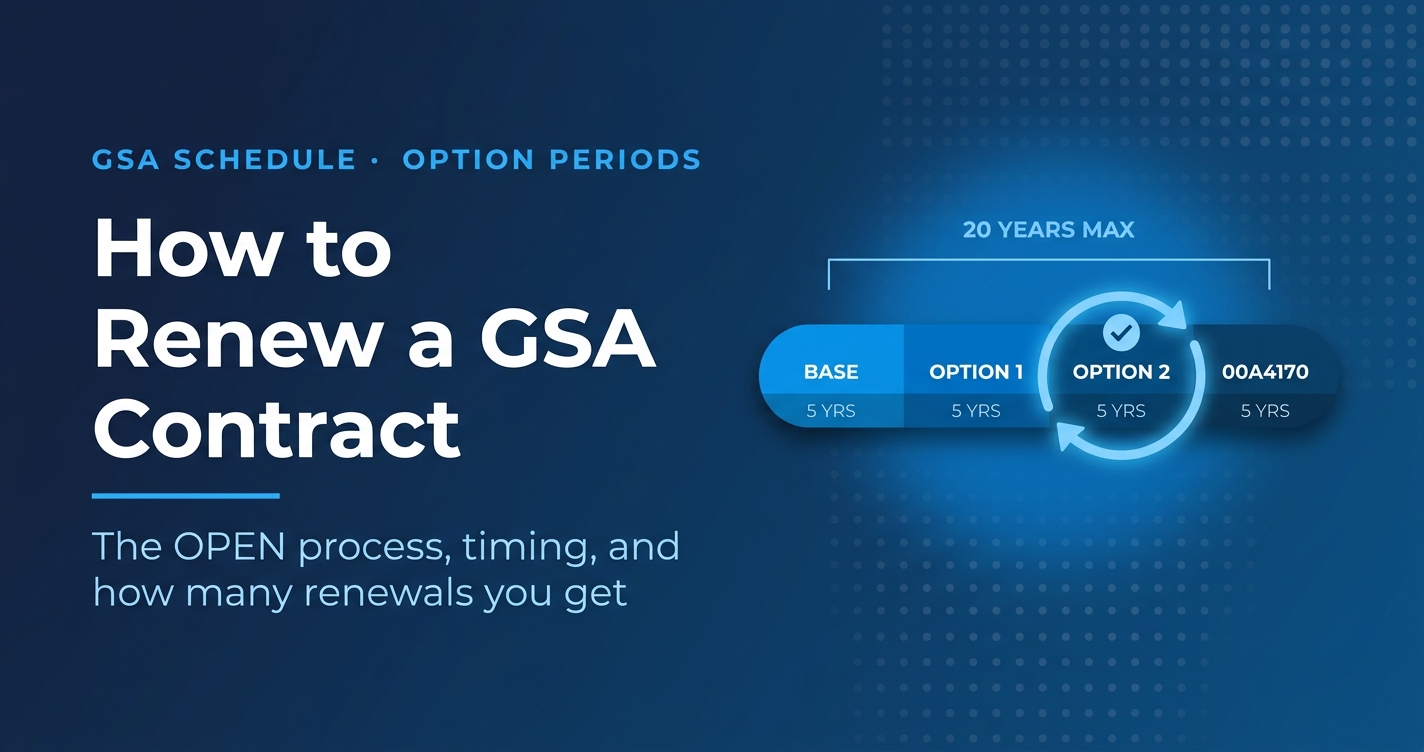
Several of these terms carry hard numbers. A Schedule runs a five-year base period plus three five-year options, for up to 20 years. You must reach $100,000 in Schedule sales during the base period and $125,000 in each option period. Contracts that miss the minimum are not renewed. Our guide to renewing a GSA contract covers the option timeline in detail.
Two of these terms trip up new contractors most often. First, “on Schedule” does not mean “listed.” Your catalog has to be live on GSA Advantage before buyers can find you. Second, adding new SINs to your GSA catalog is routine, so you do not need to cover every product line in your first offer.
If you are preparing an offer now, our GSA Schedule contract acquisition team builds the file to current Refresh 31 standards. That includes pricing documentation measured against your MFC terms.
GSA compliance acronyms that affect your contract
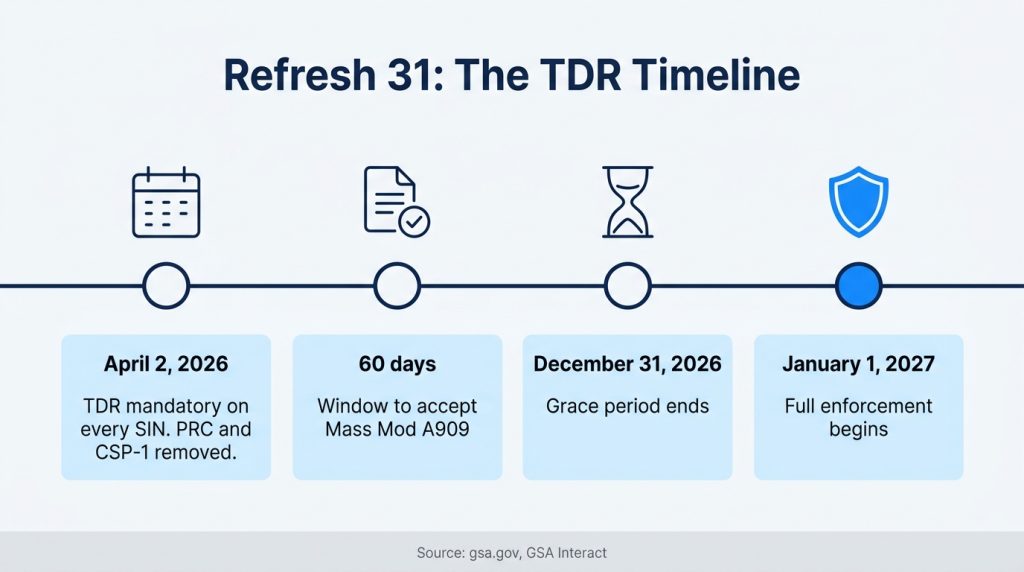
These acronyms carry dates and dollar amounts. Missing one can put an active contract at risk, even when sales are strong.
| Acronym | What it requires | Deadline or status |
| TDR | Monthly sales data through the FAS Sales Reporting Portal (SRP) | Within 30 days after each month ends |
| IFF | 0.75% of MAS sales (0.50% for VA FSS drugs only) | Within 30 days after each quarter ends |
| A909 | Mass Mod adding TDR terms under Refresh 31 | 60-day acceptance window; enforcement January 1, 2027 |
| PRC | Price Reductions Clause | Eliminated under Refresh 31 |
| CSP-1 | Commercial Sales Practices disclosure | No longer required under TDR |
| TAA | Trade Agreements Act country-of-origin rule | Applies to every product on your Schedule |
| OIG | GSA Office of Inspector General | Conducts audits of Schedule contractors |
TDR replaces the old commercial sales disclosure model with order-level data. Each monthly report covers 12 required data elements and 4 optional ones. They include your contract number, SIN, quantity, unit price, and order date (gsa.gov TDR guidance). You submit through the FAS Sales Reporting Portal, and the Vendor Support Center publishes current IFF rates and reporting help.
Here is the pattern we see most often in client files. A company’s internal procedures manual still tells staff to track commercial price reductions under the PRC. The team keeps doing that work, while the monthly TDR submission slips. Update the manual before you update anything else. For background on the change, read our post on the Price Reductions Clause and the shift to TDR reporting.
TAA deserves its own attention because it applies item by item. A single non-compliant product can trigger a modification or worse. Our TAA compliance guide for GSA contracts lists the designated countries and the certification rules.
Our GSA contract management services cover Mass Mod acceptance, monthly TDR, quarterly IFF, and catalog updates on one calendar.
Not sure your contract is TDR compliant?
An Authorized Negotiator will check your Mass Mod status, reporting calendar, and IFF payments before full enforcement begins on January 1, 2027.
Get My Free Compliance Check →Federal acquisition terms and the FAR contractor definition
Most of these terms come from three rulebooks that GSA contractors deal with directly.
- FAR: The Federal Acquisition Regulation, which governs purchasing by most executive agencies. It sits in Title 48 of the Code of Federal Regulations (CFR).
- GSAR: The GSA Acquisition Regulation, which adds GSA-specific clauses to your Schedule.
- DFARS: The Defense FAR Supplement, which layers DoD clauses onto certain orders. Firms selling to the military should review our GSA contract support for DoD contractors.
The FAR’s definition of a contractor is broader than most people expect. Under FAR 9.403, a contractor is any individual or legal entity that submits offers for, or is awarded, a government contract or subcontract. That includes doing so indirectly, such as through an affiliate. It also covers anyone doing business with the government as an agent or representative of another contractor.
The wording matters because it sits in the suspension and debarment rules. Exclusion actions can extend to affiliates, so a problem at a related company can reach yours. Check the exclusions list in SAM before you team with a new partner.
Solicitations add more government contracting terminology. Expect the statement of work (SOW), the performance work statement (PWS), and the contract line item number. Our post on what CLIN means in government contracts explains how line items tie to pricing and invoicing.
One caution: the FAR itself is being rewritten. The proposed FAR overhaul changes to Rule of Two on Schedule orders show how section numbers and rules may move. Always confirm a citation against the current text on acquisition.gov.
What are the 4 types of government contracts?
FAR Part 16 groups contract types into two broad families: fixed-price and cost-reimbursement (FAR Part 16). Most guides, however, list four types, because two other structures appear constantly in practice.
| Contract type | How you get paid | Where GSA contractors see it |
| Fixed-price (FFP) | An agreed price, regardless of your actual costs | Most MAS product orders |
| Cost-reimbursement (CR) | Allowable costs plus a fee | Outside MAS, which does not use this pricing type |
| Time-and-materials / labor-hour (T&M / LH) | Fixed hourly rates, plus materials at cost for T&M | Services and IT orders on MAS |
| Indefinite-delivery (IDIQ) | Orders placed as needs arise, within set limits | MAS itself is an IDIQ vehicle |
IDIQ is a delivery structure rather than a pricing method. Each order placed under an IDIQ carries its own pricing type, such as fixed-price or labor-hour. That is why a single MAS contract can hold both product and service orders.
Hourly pricing is the norm for federal IT and professional services firms on the Schedule. Product sellers almost always price fixed-price per unit.
Small business set-aside acronyms
These acronyms describe who gets a reserved share of federal dollars. In FY2025, the government awarded $179 billion in prime contracts to small businesses (SBA, June 2026). That is about 28% of prime dollars, against a statutory goal of 23%. On the Schedule, small businesses hold approximately 80% of MAS contracts and 36% of MAS award dollars (GSA SSQ+).
| Acronym | Stands for | FY2025 data or annual goal |
| SB | Small business | $179 billion; about 28% of prime dollars |
| SDB | Small Disadvantaged Business | $75.3 billion; 11.6% (goal reset to 5%) |
| 8(a) | SBA 8(a) Business Development program | $24.3 billion; 3.7% |
| SDVOSB | Service-Disabled Veteran-Owned Small Business | $32.5 billion in prime contracts |
| WOSB / EDWOSB | Women-Owned / Economically Disadvantaged WOSB | Goal of 5% of prime dollars |
| HUBZone | Historically Underutilized Business Zone | Goal of 3% of prime dollars |
Sources: SBA FY2025 scorecard and sba.gov. GSA itself earned an A+ on that scorecard.
You apply for WOSB, HUBZone, SDVOSB, and 8(a) status through MySBA Certifications. Agencies then decide whether to set aside a purchase, often under the Rule of Two in government contracting.
A certification only helps if buyers can see it. Your status has to appear correctly in your SAM representations, which is where the next set of terms comes in.
SAM registration terms
These terms cover the identity file every federal buyer checks before paying you. Registration at SAM.gov is free, and it is required before any federal award.
| Term | Meaning | What to know |
| SAM | System for Award Management | Renew every year; a lapse suspends payment eligibility |
| UEI | Unique Entity ID | The 12-character ID that replaced the DUNS number in 2022 |
| CAGE | Commercial and Government Entity code | A five-character code tied to your physical location |
| NAICS | North American Industry Classification System | Sets your industry and your SBA size standard |
| PSC | Product Service Code | How agencies classify what they buy |
| EIN | Employer Identification Number | Must match IRS records exactly |
| EFT | Electronic Funds Transfer | The bank details the government pays into |
| Reps and certs | Representations and certifications | Where your small business and socioeconomic status lives |
Most registrations stall on one issue. The legal name, address, or EIN does not match IRS records exactly, and entity validation stops. A clean submission can process in about a week, while a mismatch can take several weeks.
Your SAM record is also public. Scammers use real UEI and expiration data to send fake renewal notices, so learn how to avoid a government impersonation scam. Our SAM.gov registration and renewal support tracks your expiration date and handles every legitimate notice.
Is your SAM.gov registration close to lapsing?
A lapsed registration blocks payment even on orders you already delivered. We will confirm your UEI, CAGE, and reps and certs are current.
Get My Free Registration Check →GSA ordering acronyms
These acronyms describe how agencies actually buy from your Schedule. The ordering rules change with the dollar value of the order.
| Order value | How the agency buys |
| $10,000 or under | Orders directly from any MAS contractor, with no quotes required |
| $10,001 to $250,000 | Collects quotes from at least 3 MAS holders; may post an RFQ on eBuy |
| Over $250,000 | Runs a fair opportunity mini-competition among relevant MAS holders |
Source: 2026 GSA ordering thresholds.
The ordering terms to know:
- RFQ, RFP, RFI: Request for Quote, Request for Proposal, and Request for Information. On MAS, RFQs are most common.
- eBuy: GSA’s RFQ platform, open only to Schedule holders at ebuy.gsa.gov. Check it daily after award.
- GSA Advantage: The online catalog at gsaadvantage.gov, where agencies search and order.
- BPA: A Blanket Purchase Agreement an agency sets up for repeat purchases off your Schedule.
- PO: The purchase order that turns a quote into an obligation.
Small orders under $10,000 can land on GSA Advantage with no warning. A stale listing never gets those orders, so read our tips on getting found on GSA Advantage. Once orders arrive, GSA order management pulls them from Advantage, eBuy, FedMall, and DLA into one system tied to your TDR reports.
Losing track of eBuy RFQs and Advantage orders?
We will show you where orders slip through your current process, from first notice to monthly TDR report.
Get My Free Order Audit →Where contractors misread contract terminology
These are the government contracting acronyms we see misread most often when new clients bring us their files.
- EPA has two meanings. In a GSA modification, EPA means Economic Price Adjustment, not the Environmental Protection Agency. Check context before routing the document.
- A COR is not a CO. An email from a contracting officer’s representative does not change your contract. Only a warranted CO can do that in writing.
- Mass Mods look like newsletters. A Mass Mod notice can arrive looking routine. Refresh 31’s A909 gave contractors 60 days to accept, shorter than the usual 90.
- Old manuals keep old acronyms alive. PRC and CSP-1 procedures should be retired, while TDR steps get added.
- Award is not visibility. A Schedule without a current Advantage catalog is effectively invisible to buyers.
When a term in a modification is unclear, ask your CO before you sign. Our post on GSA modification types and timing explains what each change requires.
How GSA Contract Services helps
GSA Contract Services has guided contractors through GSA Schedules since 1995. We support more than 250 clients, and our team includes over a dozen Authorized Negotiators. We turn government contracting acronyms into dates on your calendar and tasks with an owner.
That work looks different by industry. Manufacturers and distributors deal most with TAA, EPA, and catalog upkeep. Service firms deal most with labor categories and hourly pricing. If you are not sure your offering fits the Schedule at all, review what GSA buys first.
Quick recap
- Government contracting acronyms tie to real deadlines, fees, and clauses in your Schedule.
- Refresh 31 made TDR mandatory on every SIN, eliminated the PRC, and dropped CSP-1.
- IFF is 0.75% of MAS sales, due within 30 days after each quarter.
- The FAR definition of a contractor reaches affiliates, so vet your teaming partners.
- SAM must be renewed every year, or payment stops.
- Ordering rules change at $10,000 and $250,000.
Frequently asked questions
What are some common acronyms used in government contracting?
The most common include GSA, MAS, SIN, FAR, SAM, UEI, CAGE, NAICS, TDR, IFF, RFQ, IDIQ, and BPA. Set-aside terms such as SDVOSB, WOSB, HUBZone, and 8(a) come up often too. The 20-term table above covers the ones GSA contractors use most.
What is GSA an acronym for?
GSA stands for the General Services Administration. It is the independent federal agency that manages procurement, real estate, and technology for the rest of the government. Its Federal Acquisition Service runs the Multiple Award Schedule program.
What is the acronym for general contractor?
The usual abbreviation is GC. In federal work, the company holding the contract with the agency is more often called the prime contractor, or simply the prime. Companies working under the prime are subcontractors.
What is the common abbreviation for contracting?
The usual shorthand in the federal market is GovCon, short for government contracting. Within a contract file, contracting officer is usually shortened to CO. DoD documents often use KO instead.
Do I need to memorize all of these government contracting acronyms?
No. Focus on the terms tied to your deadlines first: TDR, IFF, SAM, and any Mass Mod numbers on your contract. The rest you can look up as they appear in solicitations and modifications.
Find out if your business qualifies for a GSA Schedule
Tell us what you sell. An Authorized Negotiator will walk you through eligibility and the next step, at no cost for the assessment.
Get My Free Eligibility Check →