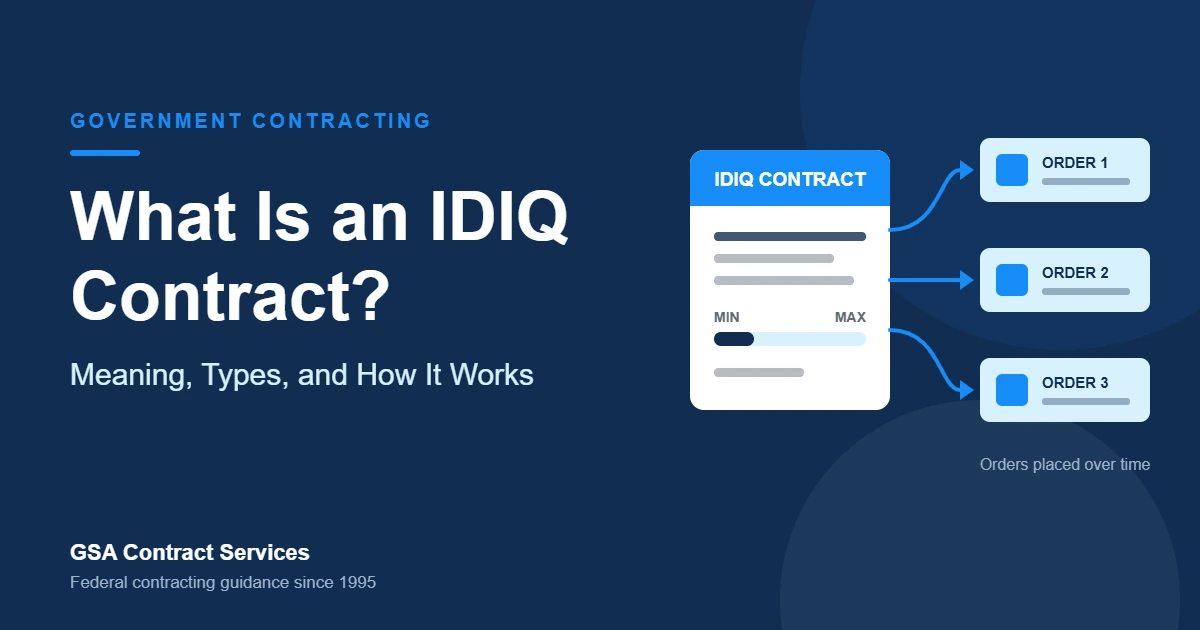
An IDIQ contract does not bring revenue on its own. It sets the terms, and revenue comes from the orders placed afterward. If you sell to federal agencies, you will meet this structure constantly.
This guide explains the IDIQ contract meaning (indefinite delivery, indefinite quantity), how orders work, the main types, and where a GSA Schedule fits.
Key Takeaways
- An IDIQ contract sets terms and prices up front, then lets the agency place orders over time.
- Only the minimum quantity is guaranteed, so award value is not the same as revenue.
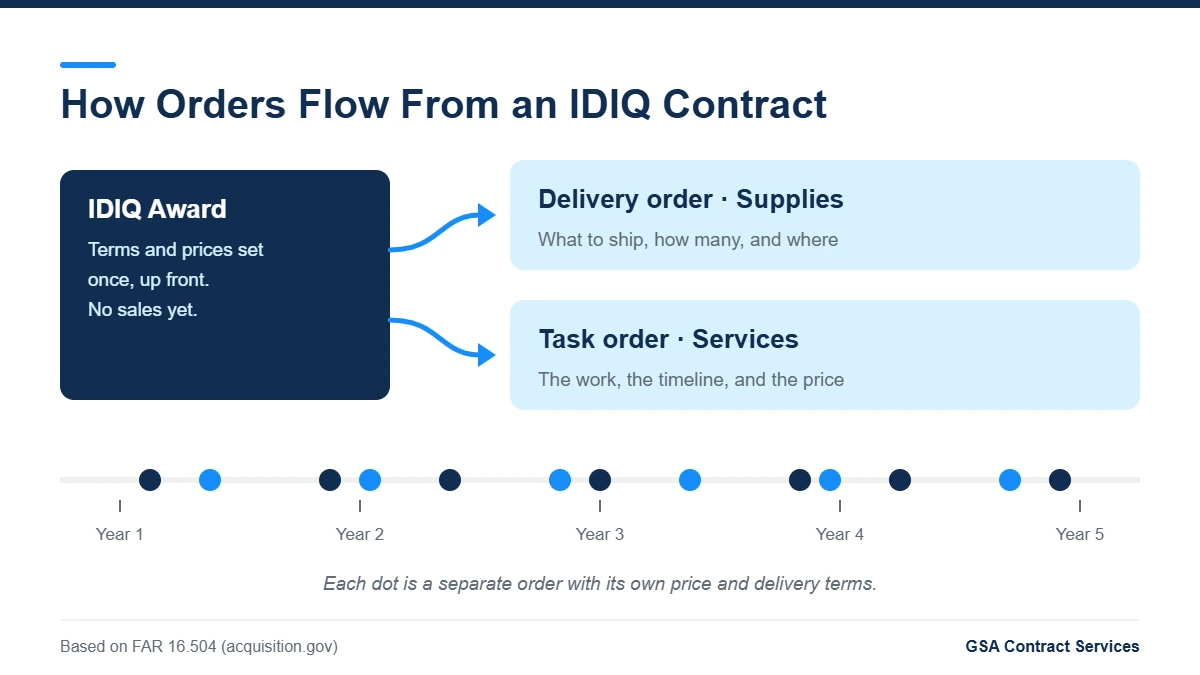
- Supply orders are delivery orders, and service orders are task orders.
- Multiple-award IDIQs compete each order through a fair opportunity process.
- A GSA Schedule works like a multiple-award IDIQ, with its own ordering thresholds.
Why IDIQ Contracts Matter More in 2026
Total federal contracting reached $793 billion in FY2025 (GAO, June 2026). Small businesses won $179 billion of the prime contracts, about 28% of the total (SBA, June 2026). You can explore where agencies spend on USAspending.gov.
A large share of that spending flows through repeat-order vehicles like IDIQs. Understanding the structure helps you decide which contracts deserve your time.
If you are new to federal sales, start with how to get government contracts for small business. Then come back here for the vehicle details.
IDIQ Meaning: What the Term Stands For
IDIQ stands for indefinite delivery, indefinite quantity. Each half tells you something about how the contract works.
- Indefinite delivery: the contract does not set exact delivery dates. Each order sets its own.
- Indefinite quantity: the contract does not set the total amount. It sets a minimum and a maximum.
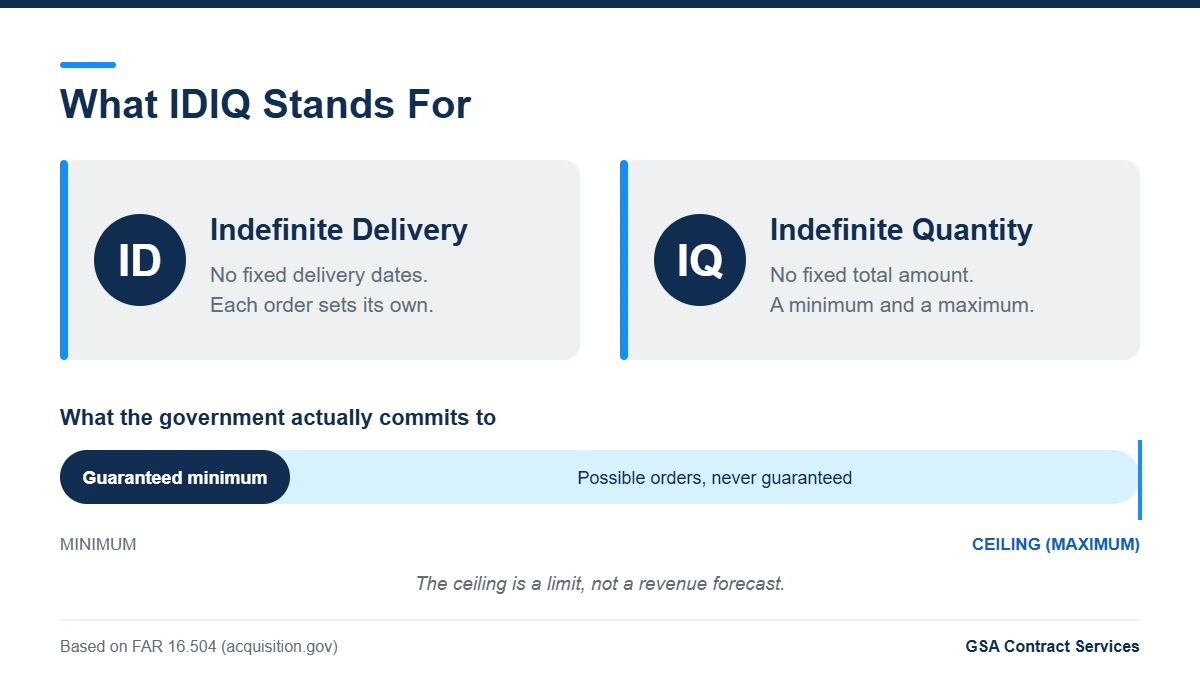
The rules come from FAR 16.504, available on acquisition.gov. The government guarantees the minimum, so the contract has real value even if few orders follow.
Contract line items, called CLINs, are how each order is priced and tracked. See what CLIN means in government contracts. Other unfamiliar terms are in our government contracting acronyms glossary.
How Orders Work After the Award
After award, the agency places orders against the contract. The name depends on what is being bought.
| Order type | Used for | What it does |
|---|---|---|
| Delivery order | Supplies (products) | Tells the vendor what to ship, how many, and where |
| Task order | Services | Describes the work, the timeline, and the price for that job |
Source: FAR 16.504 (acquisition.gov).
Each order is its own small transaction with its own price and delivery terms. That is why one IDIQ can produce dozens of orders over several years.
It also explains why a large ceiling does not guarantee large sales. Only the minimum is guaranteed.
Weighing an IDIQ Against a GSA Schedule?
We compare both against your products, pricing, and target agencies, so you chase the right vehicle.
GET YOUR OPTIONS REVIEWED →Types of IDIQ Contracts
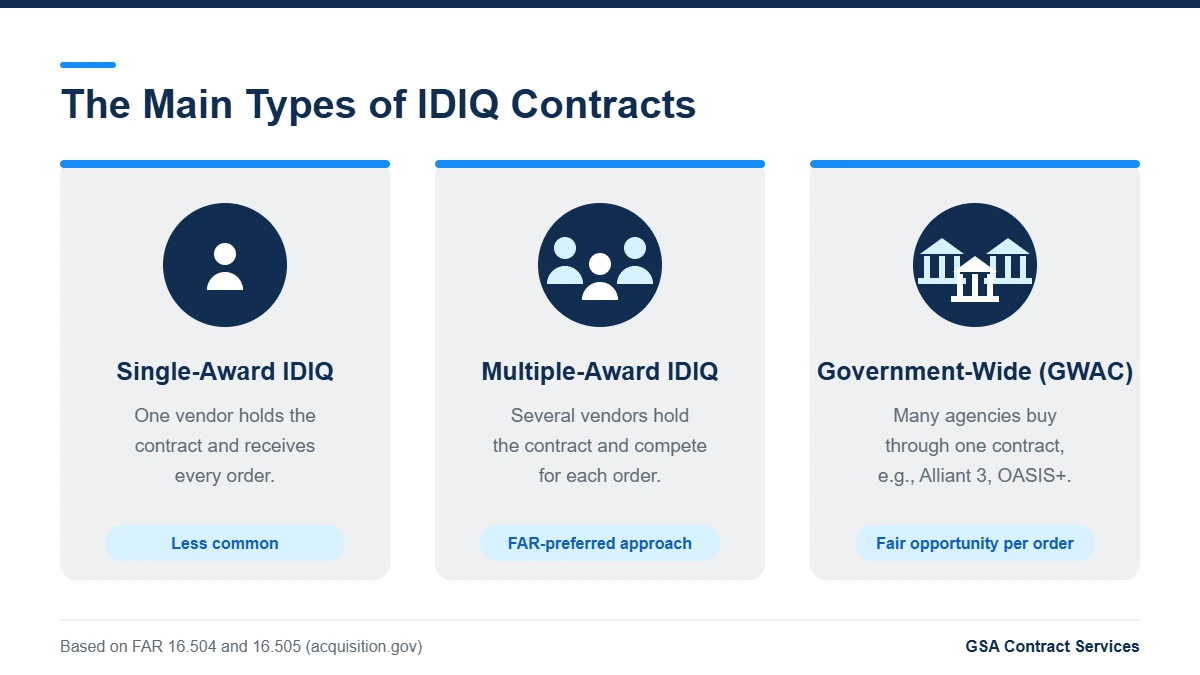
Single-award IDIQ
One vendor holds the contract and receives all orders. These are less common and face tighter rules.
Multiple-award IDIQ
Several vendors hold the same type of contract, and the agency competes each order among them. FAR 16.504 states a preference for this approach.
Government-wide contracts
Government-wide acquisition contracts (GWACs), such as GSA’s Alliant 3 and OASIS+, let many agencies buy through one contract. Orders follow a fair opportunity process under FAR 16.505, so every awardee gets a real chance to compete.
For a wider view, see our guide to types of federal contracts, including IDIQs and BPAs. Military buyers use their own mix, which is covered in GSA contract support for DoD contractors.
How a GSA Schedule Fits
A GSA Multiple Award Schedule contract works like a multiple-award IDIQ. GSA awards the contract once, and agencies place orders against it. For the program basics, read GSA contracts explained and how a GSA contract works in plain English.
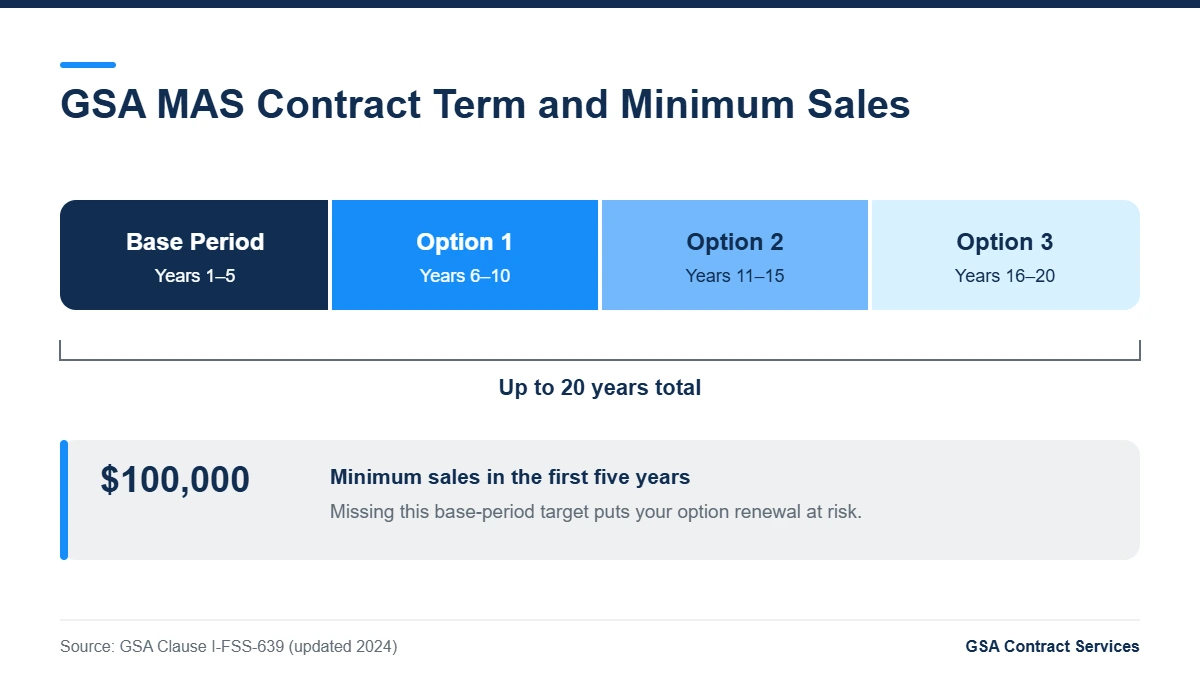
An MAS contract has a five-year base period and three five-year options, for up to 20 years. You must reach at least $100,000 in sales in the first five years (Clause I-FSS-639, updated 2024).
| Order value | How the agency buys |
|---|---|
| $10,000 or under | Orders directly from any MAS contractor, no quotes needed |
| $10,001 to $250,000 | Gets quotes from at least three MAS holders, and may post on GSA eBuy |
| Over $250,000 | Runs a fair opportunity mini-competition among relevant MAS holders |
Source: GSA, 2026 ordering thresholds.
Winning the contract gets you in the room. Winning orders depends on pricing and catalog accuracy. See GSA pricing strategies and how to get found on GSA Advantage.
Agencies buy through other channels too. Learn how state and local agencies purchase through GSA Schedules.
Where Contractors Get IDIQs Wrong
- Treating the contract ceiling as expected revenue. The ceiling is a limit, not a forecast.
- Ignoring the fair opportunity process. On multiple-award vehicles, you still compete for every order.
- Skipping the minimum sales rule. On a Schedule, missing the $100,000 base-period target puts renewal at risk.
- Waiting for orders instead of marketing. Agencies order from vendors they already know.
- Not planning for renewal. Read how to renew a GSA contract well before the option date.
How GSA Contract Services Helps
GSA Contract Services has helped federal contractors since 1995 and works with more than 250 active clients. We prepare the offer, negotiate the terms, and support the ordering phase. We can get a GSA contract for you, and our GSA contract management service handles catalogs and reporting.
Our GSA order management service helps you track orders once they arrive. Learn about SAM.gov registration and browse all GSA and federal contracting services.
TDR is now mandatory for every GSA Schedule contract on every SIN, with full enforcement beginning January 1, 2027 (GSA Interact, 2026). See how to submit monthly TDR reports.
What we handle for Schedule holders
- ✓Proposal preparation and negotiation
- ✓Catalog and order management
- ✓Mod and renewal support
- ✓Post-award compliance and TDR reporting
Quick Recap
Quick Recap
- An IDIQ contract sets terms and prices up front, then lets the agency place orders over time.
- Only the minimum quantity is guaranteed, so award value is not revenue.
- Supply orders are delivery orders, and service orders are task orders.
- Multiple-award IDIQs compete each order through a fair opportunity process.
- A GSA Schedule works like a multiple-award IDIQ, with its own ordering thresholds.
Frequently Asked Questions
What does IDIQ stand for in government contracting?
IDIQ stands for indefinite delivery, indefinite quantity. The contract sets terms and price ranges but leaves exact quantities and delivery dates to later orders.
Is a GSA Schedule an IDIQ contract?
It works like a multiple-award IDIQ. GSA awards the contract once, and agencies place orders against it. To see whether you need one, read which businesses need a GSA MAS contract.
Does an IDIQ contract guarantee I will make money?
No. The government guarantees only a minimum. Sales depend on how well you compete for each order.
What is the difference between IDIQ and BPA?
An IDIQ is a stand-alone contract with a guaranteed minimum, while a BPA is a simpler agreement that guarantees nothing. We cover the full comparison in IDIQ vs BPA vs BOA.
Ready to Turn a Contract Vehicle Into Steady Federal Sales?
Tell us what you sell and who buys it. We will map the vehicles that fit.
GET YOUR PLAN REVIEWED →Sources: FAR 16.504 and 16.505 (acquisition.gov); GAO, June 2026; SBA, June 2026; GSA, 2026; GSA Interact, 2026. Further reading: gsa.gov, sam.gov.
GSA Contract Services, LLC. Serving federal contractors since 1995.
GSA Contract Services, LLC is a private consulting firm. It is not a government agency and is not affiliated with GSA.
4622 Cedar Avenue, Suite 123, Wilmington, NC 28403 | 202-280-7060 | Sales@GSA-CS.com