
Tips for marketing your GSA Schedule as a small business start with one hard fact: an award does not bring orders on its own. Agencies can buy from you only after they find you. Most will not find you unless you put your contract in front of them.
This guide shows you how to build a GSA marketing plan, find the agencies already buying what you sell, and keep your contract productive. Every tip comes from what we see working for small business Schedule holders today.
Key Takeaways
- A GSA Schedule is a license to sell, not a sales channel. You still have to market it.
- A free GSA market analysis using SSQ+ and USAspending.gov shows which agencies buy what you sell.
- Orders of $10,000 or less need no quotes, so end users who know your name can buy from you directly.
- Check GSA eBuy every business day. Only Schedule holders can see and answer those requests.
- Compliance is part of marketing. The TDR grace period ends December 31, 2026, and enforcement starts January 1, 2027.
Why GSA Schedule Marketing Matters More in 2026
The GSA Multiple Award Schedule closed FY2025 with $50.6 billion in total sales (GSA SSQ+, 2025). Small businesses earned 36% of those award dollars (GSA SSQ+, 2025). That opportunity explains why roughly 80% of all MAS holders are small businesses (GSA / Summit Strategy).
However, holding a contract and selling through it are two different things. GSA is now removing contracts that do not perform. The active contractor base fell from 16,108 in FY2024 to approximately 14,579 in FY2025, roughly 1,500 contracts gone in a single year (GSA SSQ+).
The reason is the sales floor. Every contract must generate at least $100,000 in Schedule sales during its first five-year base period, and GSA enforces that minimum during GSA contract renewal (Clause I-FSS-639). In short, GSA Schedule marketing is no longer optional. It decides whether you keep the contract you worked hard to win.
Before building a plan, it helps to be clear about what GSA marketing actually covers.
GSA Marketing Definition: What It Means for a Schedule Holder
Here is a working GSA marketing definition: every activity that helps federal buyers find, trust, and order from your Schedule. If you need a refresher on the vehicle itself, start with how a GSA contract works. That includes your GSA Advantage catalog, your eBuy responses, your capability statement, and your direct outreach to agency buyers.
It differs from commercial marketing in one important way. Federal buyers follow ordering rules tied to spending thresholds. Therefore, your job is not to create demand from scratch. Instead, you position your company where agencies already look when they need to buy.
With that definition in place, here are the nine tips that make the biggest difference for small businesses.
Tip 1: Write a GSA Schedule Marketing Plan Before You Chase Orders
Most new contractors start by emailing every agency they can think of. A GSA Schedule marketing plan replaces that scattered effort with a short target list and a weekly routine.
It does not need to be long. A two-page GSA marketing plan that you follow every week beats a 30-page deck that sits in a folder. Cover these seven elements:
| Plan element | What to write down |
| Target agencies | 5 to 10 agencies that already buy your SINs, ranked by spend |
| Target buyers | Contracting offices, small business specialists, and end-user program offices within each agency |
| Competitors | The Schedule holders winning those orders today, and how their pricing compares to yours |
| Channels | GSA Advantage, GSA eBuy, direct outreach, and teaming partners |
| Weekly activity | Daily eBuy checks, catalog updates, and a set number of buyer contacts each week |
| Sales goal | An annual target, measured against the $100,000 base-period minimum |
| Metrics | eBuy requests answered, quotes won, website contract-page visits, and reported Schedule sales |
The plan is only as good as the data behind it. That is where a market analysis comes in.
Tip 2: Run a GSA Market Analysis Using Free Federal Data
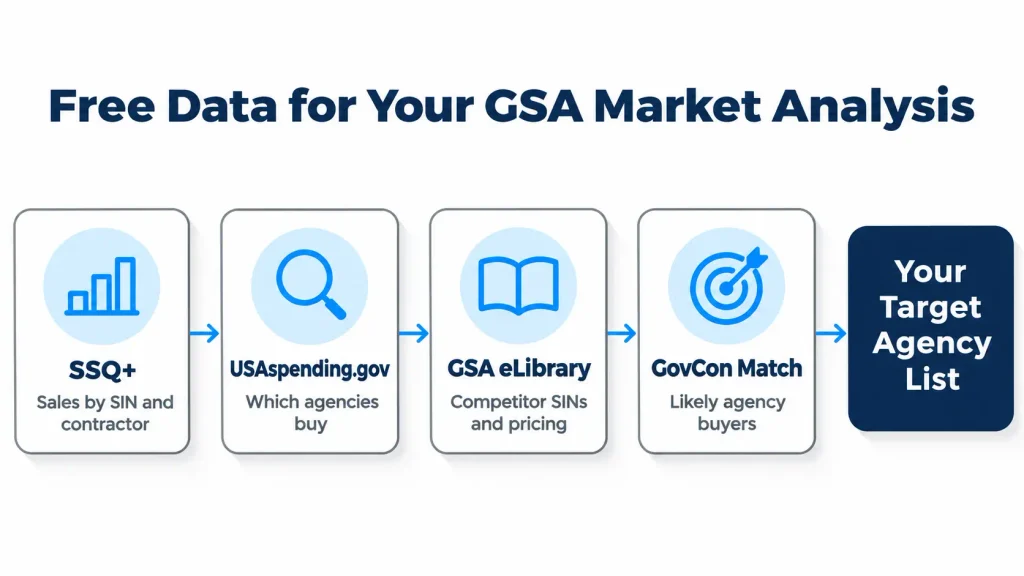
A GSA market analysis answers three questions. Which agencies buy what you sell? How much do they spend? And who are they buying from today? You can answer all three without paying for a subscription database.
- Pull category sales in Schedule Sales Query Plus (SSQ+). Filter by your SIN to see total sales and the top contractors in your category.
- Search USAspending.gov by NAICS and product or service code. Note which agencies and offices award the most orders.
- Look up competitors in GSA eLibrary. Review their SINs, contract terms, and published price lists. If your own SINs are too narrow, see our guide to choosing the right GSA SINs.
- Run your profile through SBA’s GovCon Match tool. It suggests agencies likely to buy from businesses like yours.
Here is the part most small businesses skip. They look at total category sales and stop there. However, the useful insight is concentration. If three agencies account for most of the spending in your SIN, those three belong at the top of your plan.
Once you know who is buying, the next step is measuring your competition.
Tip 3: Build a GSA Market Report to Benchmark Competitors
A GSA market report is a snapshot of reported Schedule sales in your category over time. You can build one yourself from SSQ+ exports in a spreadsheet. Sort contractors by sales, then track the top ten across the last eight quarters.
For a view of who leads the program overall, see our breakdown of the top GSA contractors in 2026. Small firms rarely compete with those names directly, but their SINs show where federal money concentrates.
This report tells you whether your category is growing, flat, or shrinking. For example, the IT Category and Professional Services lead all MAS categories by sales (GSA SSQ+, FY2025). Still, a crowded category can hide a small group of underserved buyers.
As a result, the report also gives you realistic targets. Look at what the tenth-ranked contractor in your SIN sells each quarter. That number is a practical first-year benchmark.
Data tells you where buyers are. Your catalog decides whether they find you.
Tip 4: Make Your GSA Advantage Catalog Easy to Find
GSA Advantage is the online catalog where federal buyers search, compare, and order Schedule products. Contracting officers skip listings with stale pricing or missing product data. An outdated catalog makes your contract effectively invisible, no matter how good your products are.
- Write product titles the way buyers search, including the manufacturer part number.
- Add clear photos and complete descriptions for every item.
- List accurate delivery times. Buyers can filter by delivery, and short lead times stand out.
- Flag your socioeconomic status so buyers seeking set-aside credit can find you.
- Plan pricing updates ahead. Increases are capped at 10% per category item per year unless you justify more.
- Submit GSA contract modifications promptly when you add products or change prices.
Keeping hundreds of line items current is where most small teams fall behind, as we explain in why monthly GSA catalog updates become a recurring problem. Our EDI and XML catalog services handle those uploads for you.
A clean catalog captures buyers who are already searching. GSA eBuy lets you reach buyers who are asking.
Is Your GSA Advantage Catalog Costing You Orders?
Our team reviews your catalog, pricing, and eBuy setup, then shows you what federal buyers see when they search for you.
Get Your Catalog Reviewed →Tip 5: Check GSA eBuy Every Business Day
GSA eBuy is the request-for-quote platform that only Schedule holders can access. Agencies post RFQs and RFIs there, often with short response windows. If you check it once a week, you will miss requests that open and close within days.
Set notifications for every SIN on your contract. In addition, answer RFIs as well as RFQs. An RFI response takes little time, and it puts your company on the buyer’s radar before the formal request goes out. Our guide on how to bid on government contracts covers how to write responses that win.
Responding to posted requests matters. Still, the strongest sales come from buyers who know you before they post anything.
Tip 6: Match Your Outreach to GSA Ordering Thresholds
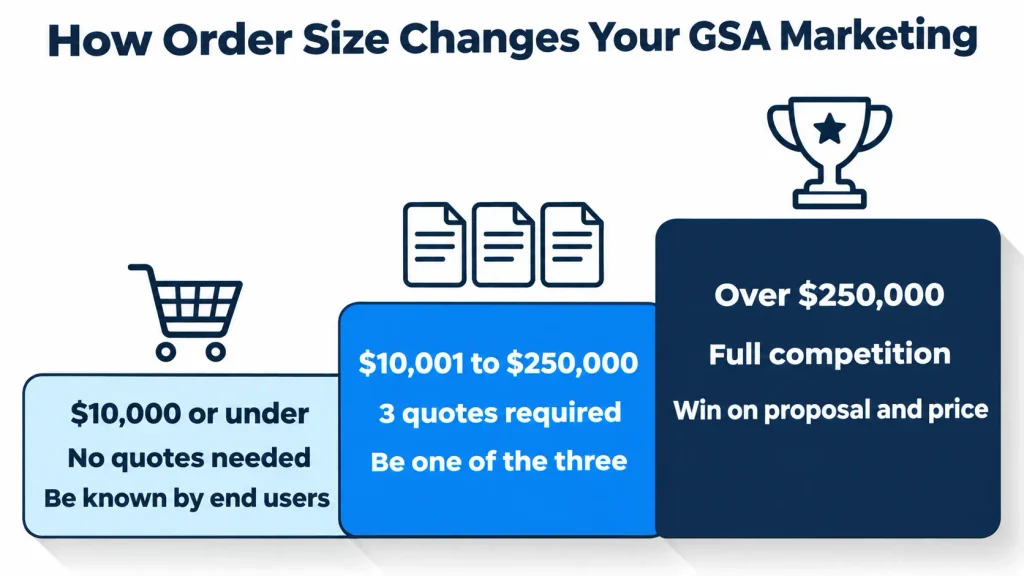
Marketing to the federal government through GSA works best when you understand how buyers are allowed to purchase. The order value decides the process, and each threshold calls for a different approach.
| Order value | How agencies buy | Your marketing focus |
|---|---|---|
| $10,000 or under | Direct order from any MAS contractor, no quotes needed | Build name recognition with end users and purchase cardholders |
| $10,001 to $250,000 | Quotes from at least 3 MAS holders; may post on GSA eBuy | Be one of the three companies the buyer thinks of first |
| Over $250,000 | Fair opportunity competition among all relevant MAS holders | Strong past performance, sharp pricing, and a clear written response |
Source: GSA MAS ordering procedures, 2026
This is the detail many small businesses miss. In the middle tier, buyers often request quotes from vendors they already know. Therefore, a short introductory call or capability statement sent months earlier can decide who receives the RFQ.
Agencies that buy the same items often may also set up a Blanket Purchase Agreement against your Schedule. Learn how BPAs and other vehicles differ in types of federal contracts. When those orders start arriving, our GSA order management service processes them so nothing slips.
Being remembered depends on what buyers see when they look you up.
Tip 7: Put GSA Contract Marketing on Your Website and Capability Statement
When an agency buyer hears your name, the first thing they do is search for you. Your website should confirm in seconds that you hold a GSA Schedule. Good GSA contract marketing makes that confirmation easy.
- A dedicated GSA Schedule page with your contract number, SINs, and contract period
- A link to your GSA Advantage listing and a downloadable price list
- Your UEI, CAGE code, NAICS codes, and any SBA certifications, all matching an active SAM.gov registration
- A one-page capability statement covering core competencies, past performance, and differentiators
- GSA logo use only within GSA’s published guidelines
Keep the capability statement to one page. Contracting officers scan these quickly, so lead with what you sell and the contract vehicle they can use to buy it. Unsure what an abbreviation means? Our government contracting acronyms glossary explains them.
Your own materials reach buyers one at a time. Certifications and partners multiply that reach.
Tip 8: Expand Your Reach With Set-Aside Certifications and Teaming
People often ask how to market to GSA buying companies. The answer starts with who the buyers are. Schedule orders come from federal agencies and certain eligible state and local entities, not private companies. See how state and local agencies purchase through GSA Schedules for who qualifies.
However, large prime contractors also look for small Schedule holders as subcontractors and partners. Introduce yourself to the primes winning work in your category, not just to agencies.
Set-aside certifications give agencies another reason to choose you. For example, service-disabled veteran-owned small businesses received $32.5 billion in prime contracts in FY2025 (SBA, June 2026). You can apply for WOSB, HUBZone, SDVOSB, and 8(a) status through SBA’s MySBA Certifications portal. Certifications matter most under the Rule of Two, which reserves many buys for small businesses.
Teaming is the other option. A GSA Contractor Team Arrangement lets two or more Schedule holders combine offerings to meet a larger requirement. As a result, a small firm can compete for orders it could not win alone.
Tip 9: Treat Compliance as Part of Your GSA Schedule Marketing
Marketing your GSA Schedule only works while the contract stays in good standing. As of April 2, 2026, Transactional Data Reporting (TDR) is mandatory on every MAS SIN through Refresh 31 (gsa.gov). The grace period ends December 31, 2026, and full enforcement begins January 1, 2027 (GSA Interact).
TDR reports are due monthly, within 30 days after each month ends, through the FAS Sales Reporting Portal. Our walkthrough shows how to submit monthly TDR reports step by step. The Industrial Funding Fee of 0.75% is due quarterly (vsc.gsa.gov). A lapsed SAM.gov registration suspends payment eligibility until you renew it. TDR also replaced the old Price Reductions Clause, which we cover in the shift from PRC to TDR reporting.
In other words, every hour you spend on outreach depends on a contract in good standing. Keep the reporting calendar as tight as your sales calendar.
How to Market Your GSA Schedule: A 90-Day Starter Plan
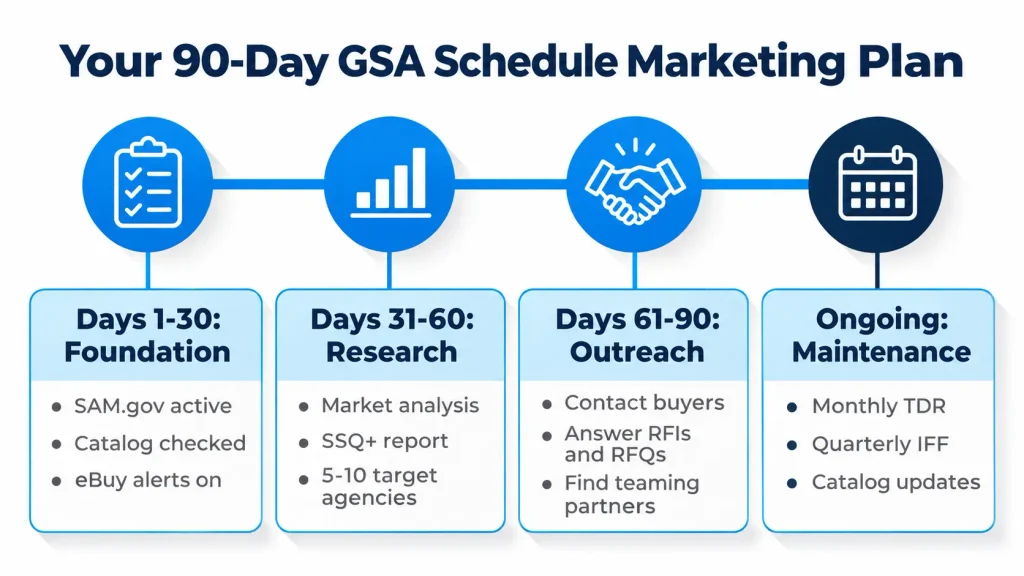
If you are wondering how to market your GSA Schedule right after award, this sequence gives you a realistic starting point.
| Timeframe | Focus | Actions |
|---|---|---|
| Days 1 to 30 | Foundation | Confirm SAM.gov is active, check your GSA Advantage catalog, set eBuy notifications, publish your GSA page and capability statement |
| Days 31 to 60 | Research | Complete your market analysis, build your first SSQ+ market report, choose 5 to 10 target agencies |
| Days 61 to 90 | Outreach | Contact small business specialists at target agencies, answer eBuy RFIs and RFQs, approach two or three teaming partners |
| Ongoing | Maintenance | Monthly TDR reports, quarterly IFF payments, catalog updates, and a quarterly plan review |
Where Small Businesses Get GSA Schedule Marketing Wrong
These five patterns show up again and again with new Schedule holders. Each one is easy to fix once you see it.
- Waiting for orders to arrive. The award places you in the catalog. It does not place you in front of buyers.
- Targeting every agency at once. Spreading effort across dozens of agencies leaves no time for the few that buy the most.
- Letting the catalog go stale. Outdated pricing and missing products push you out of buyer consideration.
- Ignoring the sales floor. Renewal review begins 210 days before expiration, so a slow year four leaves little time to reach $100,000.
- Separating compliance from sales. A missed TDR report or lapsed registration can undo months of outreach.
How GSA Contract Services Helps Small Businesses Market Their Schedules
GSA Contract Services has supported federal contractors since 1995. We work with more than 250 active clients, and our team includes more than a dozen Authorized Negotiators. That experience covers both sides of the work: winning the contract and keeping it productive.
Our GSA contract management service handles catalog updates, contract modifications, TDR reporting, and IFF payments. That frees your team to focus on marketing your GSA Schedule to agency buyers. If you do not hold a Schedule yet, our team can help you get a GSA contract from offer to award. You can see the full list of GSA and federal contracting services we provide.
Quick Recap
The best tips for marketing your GSA Schedule as a small business come down to focus and consistency:
- Write a short marketing plan built around 5 to 10 target agencies.
- Use SSQ+, USAspending.gov, and GSA eLibrary for a free market analysis.
- Keep your GSA Advantage catalog current, complete, and searchable.
- Check eBuy daily and answer RFIs, not just RFQs.
- Treat TDR, IFF, and SAM.gov compliance as part of your sales effort.
Frequently Asked Questions
When should you start marketing your GSA Schedule after award?
Start on day one. The five-year base period passes faster than most contractors expect, and the $100,000 minimum applies to the whole period. Early outreach gives you more quarters to build buyer relationships. Not sure your company is a fit yet? Check which businesses need a GSA MAS contract.
What is the difference between a GSA marketing plan and a business plan?
A business plan covers your whole company. A GSA marketing plan focuses only on federal buyers who can order through your Schedule. It lists target agencies, channels, weekly actions, and a sales goal tied to your contract minimum.
How do you market to GSA buying companies?
Schedule buyers are federal agencies and eligible state and local entities, not private companies. However, large prime contractors often look for small Schedule holders as subcontractors or partners. Therefore, introduce yourself to agency buyers and to the primes in your category.
Can a consultant handle the marketing work for me?
A consultant can run the catalog, modification, and compliance work that keeps your Schedule visible, and help you build the plan. Relationship building with agency buyers still works best when it comes from your own team.
Ready to Turn Your GSA Schedule Into Steady Federal Sales?
Talk with a GSA Contract Services advisor about your catalog, compliance, and marketing plan.
Get Your Marketing Plan Reviewed →GSA Contract Services, LLC | Serving federal contractors since 1995
4622 Cedar Avenue, Suite 123, Wilmington, NC 28403 | 202-280-7060 | Sales@GSA-CS.com